Due diligenceSixteen questions to put to any on-premise document AI vendor
Written to be pasted straight into an RFP. Every one has a verifiable answer, and a vendor who cannot answer in writing has told you something useful.
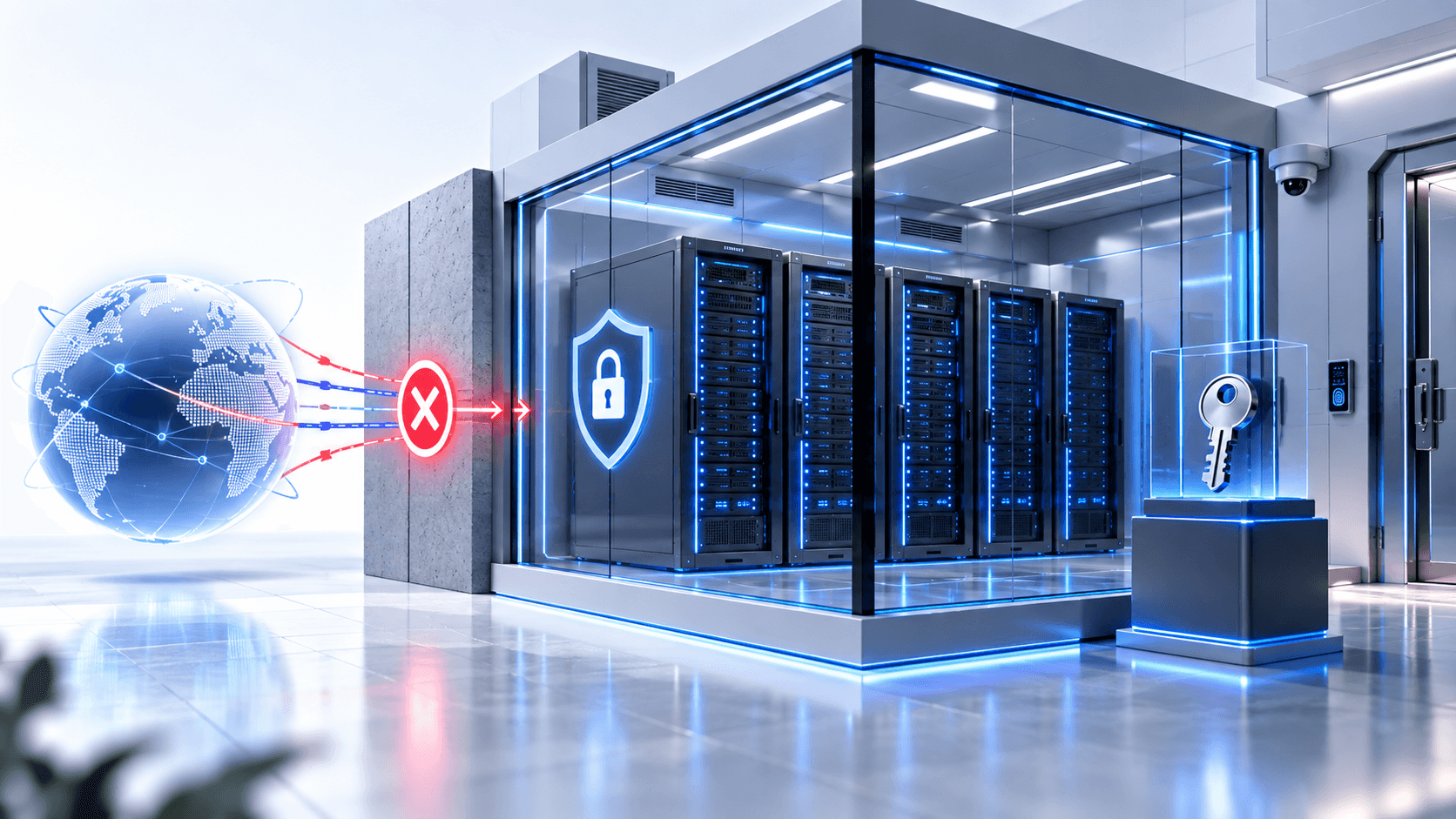
Data path and egress
- 1. Can we see a complete data-flow diagram?
- Every stage, every store and every outbound connection, including licensing, telemetry and model distribution. Not a marketing architecture slide.
- 2. What happens with the outbound route removed?
- Does the product start, process and complete normally, or does it degrade, queue or fail? Ask for this to be demonstrated, not described.
- 3. Is there any fallback to a cloud model?
- Some products silently escalate low-confidence pages to a hosted model. Ask explicitly, because it will not appear in the summary datasheet.
- 4. Is any document, text or embedding cached by the vendor?
- If yes: what exactly, for how long, in which jurisdiction, and can it be disabled without losing function?
Models and custody
- 5. Will you provide a full model manifest?
- Named model, version, licence and purpose for every component: OCR, layout, classification, extraction and any language model.
- 6. Where do the weights physically live?
- On storage we control, or pulled from a vendor registry at runtime? These have different answers in an audit.
- 7. Are the model licences valid for offline commercial use?
- Some open-weight licences restrict commercial deployment or redistribution. Get the licence text, not the licence name.
- 8. Can our documents ever be used for training?
- Ask for a contractual exclusion, not a policy statement. In a true on-premise deployment there is no mechanism for it, which should be evident in the diagram from question one.
Operations and continuity
- 9. How do updates reach an offline deployment?
- Signed, versioned offline packages imported on your schedule, with a changelog and re-validation report, or an internet pull you cannot permit.
- 10. Can we roll back a model version?
- Model changes shift extraction behaviour. You need the previous version retained and a documented rollback path.
- 11. What is the high-availability and disaster-recovery design?
- Worker redundancy, queue durability, restore procedure and measured recovery objectives against your volume.
- 12. How is the deployment supported without remote access?
- Log bundles you review and release, scheduled escorted sessions, or on-site attendance. Agree this before an incident, not during one.
Commercial and evaluation
- 13. On which commercial tier is on-premise available?
- If it is enterprise-only or quote-only, the deployment you need is not the one described by the published pricing.
- 14. What is the all-in first-year cost?
- Licence or subscription, setup and implementation fees, hardware, and the cost of the volume you will actually process.
- 15. Will you commit to a field-level accuracy threshold on our documents?
- On your document set, measured field by field with an adjudicated ground truth, with the remediation path written into the contract.
- 16. What keeps running if the contract ends?
- Extracted data, deployment images, model artifacts and the licence position on each. Establish this before signature.
Ask DocxIntel all sixteen. The Proof of Value is structured so that the answers can be verified in your own environment, with your own logs and your own documents, rather than accepted on trust.