
DocxIntel home
DocxIntel, a product of BizfyLabs
by
BizfyLabs
  • Capabilities
    • Analyse

      Resolve layout, reading order, tables and handwriting

    • Identify

      Pull entities, fields and clauses with coordinates

    • Classify

      Sort document types and split multi-page packets

    • Map

      Link and reconcile entities across your estate

    • Modify

      Redact, mask and transform documents safely

    • Ask

      Query your documents and get cited answers

    • All six capabilities, one platform→
  • Deployment
  • Accuracy
  • Industries
    • Banking & Financial Services

      Statements, KYC files, and financial filings

    • Insurance

      Claims, policies, and underwriting documents

    • Government & Public Sector

      Records, correspondence, and regulatory filings

    • Healthcare

      Patient records, referrals, and lab reports

    • Legal & Compliance

      Contracts, filings, and case documentation

    • Energy & Utilities

      Engineering documents, contracts, and reports

    • Every regulated industry we serve→
  • Pricing
  • Docs
Book a Demo
Home
DocXIntel

Menu

    • All capabilities
    • Analyse
    • Identify
    • Classify
    • Map
    • Modify
    • Ask
    • All industries
    • Banking & Financial Services
    • Insurance
    • Government & Public Sector
    • Healthcare
    • Legal & Compliance
    • Energy & Utilities
    • Deployment models
    • Reference architectures
    • Sizing & throughput
    • What's in the box
    • Security posture
    • Documentation
    • Accuracy benchmark
    • Pricing
    • Proof of Value
    • Compare
    • About
    • FAQ
    • Contact Us
Industry — Insurance

Insurance document processing that never sends a claim file outside your network.

Insurers and TPAs receive claims as whatever the claimant could photograph or fax. DocxIntel splits those packets, reads the handwritten Arabic forms and stamped garage invoices inside them, reconciles the claim against the policy schedule and flags the invoices that do not add up — all on your own hardware.

  • Auto-split claim packets
  • Handwritten Arabic forms
  • Runs air-gapped
  • No per-page charge
Book a claims walkthrough
See the accuracy benchmark
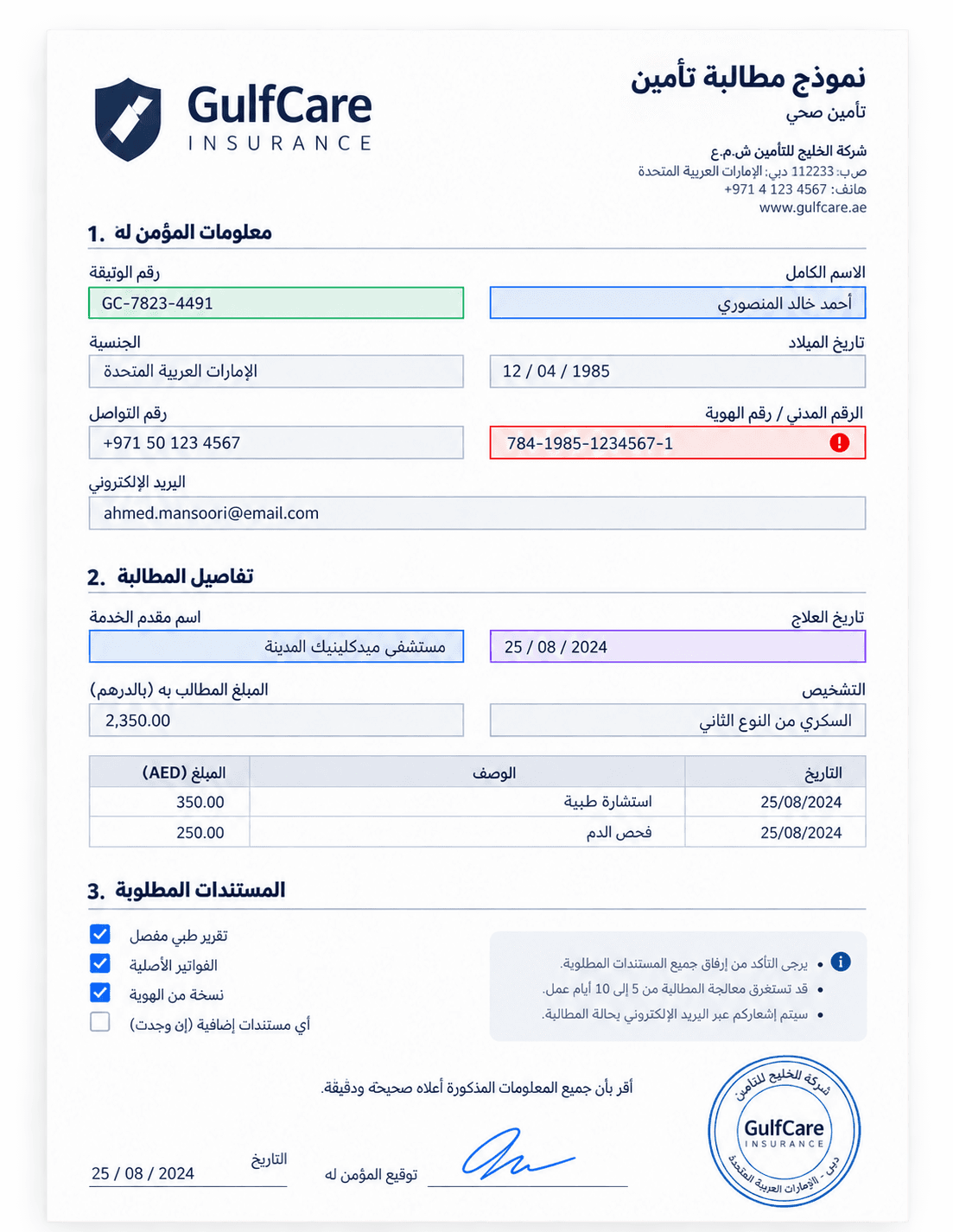
An Arabic insurance claim form with extracted fields traced back to their coordinates on the page
99%
Field-level accuracy
on the published benchmark set
Auto-split
Mixed claim packets
one scan, many documents
AR + EN
Native script support
including handwritten forms
Unmetered
Claim pages processed
fixed annual licence

Accuracy is measured field-by-field against a human-adjudicated ground truth, not character-by-character. Your own threshold is set on your own claim documents during the Proof of Value, and it is the number the engagement is judged on.

What it processes

The insurance documents and workflows that consume handler time

Claims do not arrive as clean forms. They arrive as a WhatsApp photograph of a police report, a stamped garage estimate, a discharge summary and an IBAN letter, all in one email — and someone has to sort it before anyone can assess it.

Claim intake and packet auto-split

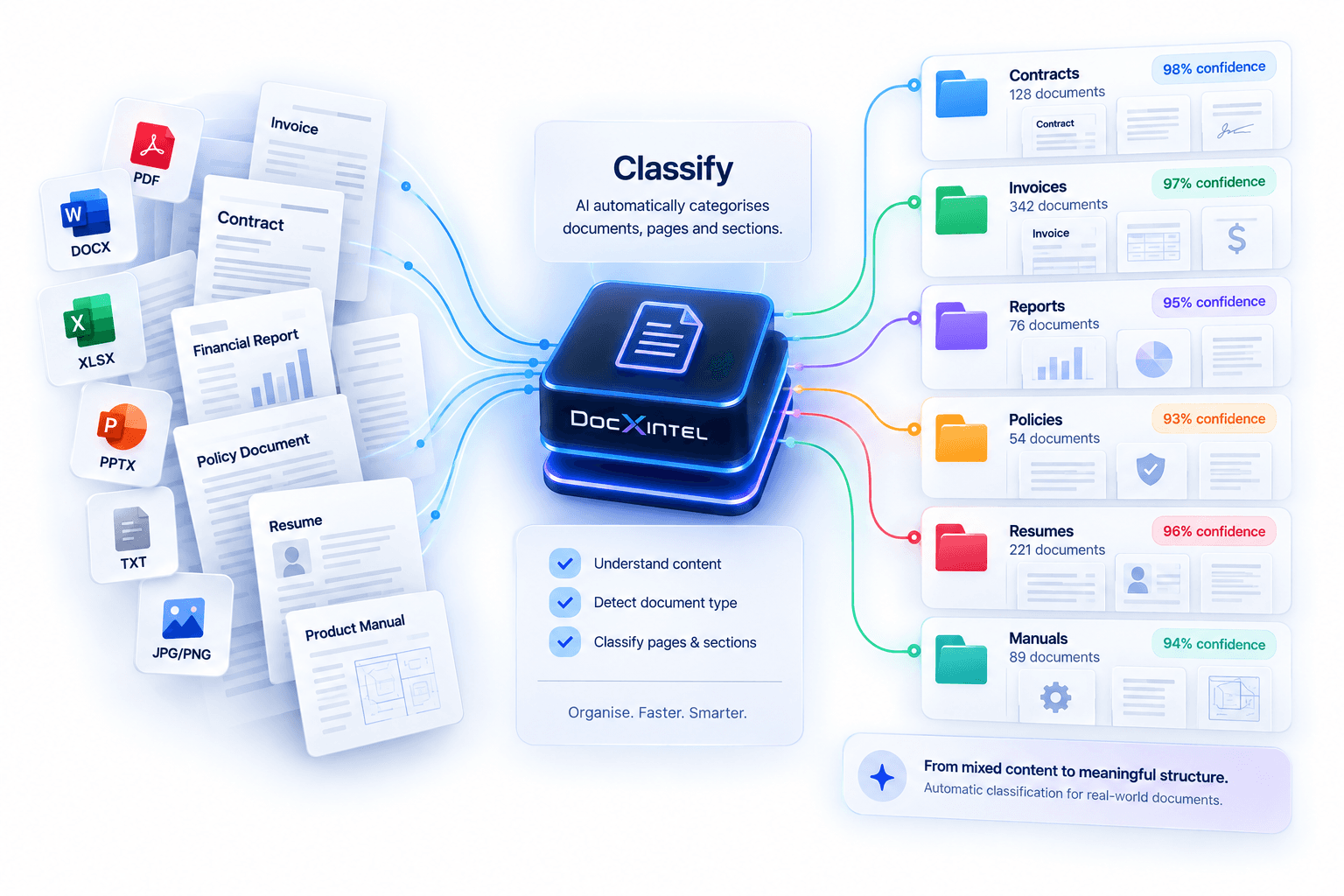
Every page in an incoming packet is classified, then the packet is split into its component documents with the right pages attached to each. Handlers open a structured claim file rather than a 40-page scan.

  • Page-level classification
  • Automatic document boundaries
  • Email, portal and scanner intake

Motor claim documents

FNOL forms, police reports, vehicle registration cards, driving licences, garage estimates and final repair invoices are read together, including stamps and signatures over printed totals.

  • Estimate against final invoice
  • Registration and licence details
  • Stamp-over-text separation

Medical claim documents

Medical reports, discharge summaries, lab results, pharmacy invoices and reimbursement forms are extracted with diagnosis, procedure and amount fields intact, including handwritten physician entries.

  • Handwritten clinical entries
  • Itemised invoice line detail
  • Diagnosis and procedure codes

Claim-versus-policy reconciliation

Extracted claim values are checked against the policy schedule: cover in force on the incident date, sub-limits, deductibles, exclusions and the named insured. Mismatches are raised as specific findings.

  • Cover-in-force date checks
  • Sub-limit and deductible logic
  • Named-insured matching

Fraud and leakage signals

Duplicate and near-duplicate invoices, amounts that disagree between documents, recycled repair photographs and totals whose ink does not match the surrounding print are flagged for investigation.

  • Duplicate invoice matching
  • Altered-amount detection
  • Cross-claim provider patterns

Reimbursement and subrogation files

Reimbursement forms, receipts and bank details are captured for payment, and subrogation files are assembled with the recovery evidence already indexed and cited.

  • IBAN and payee capture
  • Receipt totals and dates
  • Recovery evidence indexing
End to end

A motor claim, from a photographed packet to a reconciled claim file.

This is the workflow insurers ask us to prove first, because it is where the handler time actually goes. Nothing in it involves a page leaving your data centre.

  • The packet lands from the claims mailbox or portal — 38 pages, mixed Arabic and English, several taken on a phone
  • Pages are quality-corrected, classified and split into an FNOL form, a police report, a registration card, two garage estimates and an invoice
  • Fields are extracted per document type with page number, bounding box and confidence attached to every value
  • The claim is reconciled against the policy schedule: cover in force on the incident date, deductible, sub-limits, named insured
  • The final invoice is matched against the approved estimate, and the delta is raised as a specific finding rather than a score
  • A structured claim file is written back to your claims system, with the 3% of low-confidence fields routed to a review queue

Every value in that claim file can be clicked back to the pixels it came from, which is what makes a settlement decision defensible months later.

See how classification works
A mixed insurance claim packet being split into separate classified documents with confidence scores
Rollout

How an insurance deployment actually starts

One line of business first, measured on your own claim files, before anything touches the rest of the book.

  1. 1
    Step 1

    Pick one line of business and its worst packets

    Motor or medical, whichever generates the most manual handling. We ask for the packets your team dreads — the photographed forms, the third-generation faxes, the handwritten Arabic FNOLs — because those decide whether the number holds in production.

  2. 2
    Step 2

    Agree the document types and the field schema

    Which documents you expect in a packet, which fields each one must yield, and which of those fields are payment-critical. Payment-critical fields get tighter confidence thresholds than descriptive ones.

  3. 3
    Step 3

    Install inside your perimeter

    Containers and open-weight models are deployed on your hardware — air-gapped, private cloud or managed single-tenant. Your infrastructure team holds root and the encryption keys; no claim data is visible to us.

  4. 4
    Step 4

    Wire in reconciliation and fraud rules

    Policy-schedule checks, sub-limit logic, estimate-versus-invoice tolerance and duplicate-invoice matching are configured against how your handlers already work, then tuned on historical claims where the outcome is known.

  5. 5
    Step 5

    Measure against the written threshold

    Your reviewers adjudicate field-by-field and the report shows per-field accuracy, confidence distribution and the exception rate you would actually staff for. Miss the agreed threshold and you keep the report and owe nothing further.

  6. 6
    Step 6

    Extend to the rest of the book

    Adding health to a motor deployment, or reprocessing three years of settled claims for a subrogation review, is a configuration change and some GPU time. The licence does not move because the volume did.

Reference

Insurance document types and the fields extracted from each

An indicative schema. The final field list is agreed against your own forms during the Proof of Value, not taken from a template library.

Claim intake documents

FNOL / claim notification form
Claim reference, policy number, insured name, incident date and time, location, loss description, reporting channel, declarant signature and date
Police report
Report number, issuing authority, incident date, parties and vehicles involved, fault allocation, plate numbers, officer stamp and signature
Vehicle registration and driving licence
Plate number, chassis and engine number, make, model, year, owner name, licence number, category, issue and expiry dates
Garage estimate and repair invoice
Garage name and trade licence, estimate or invoice number, date, parts and labour lines, per-line amounts, VAT, total, approval stamp

Medical and reimbursement documents

Medical report
Patient name and identifier, provider and clinician, consultation date, presenting complaint, diagnosis, prescribed treatment, clinician signature
Discharge summary
Admission and discharge dates, admitting diagnosis, procedures performed, length of stay, discharge medication, follow-up instructions
Provider invoice
Provider identifier, invoice number and date, itemised service lines, service codes, unit amounts, VAT, patient share, net payable
Reimbursement form and receipts
Member and policy number, claimed amounts per receipt, receipt dates, currency, bank name, IBAN, payee name, member declaration

Policy and recovery documents

Policy schedule
Policy number, insured and additional insureds, period of cover, sums insured, sub-limits, deductibles, endorsements, listed exclusions
Subrogation file
Claim and policy references, third-party details, recovery basis, supporting evidence index, amounts paid and amounts sought, correspondence dates
Attached to every field
Page number, bounding-box coordinates, confidence score and a stable element identifier that survives re-runs

Handwritten fields, stamped fields and fields recovered from photographed pages carry the same provenance metadata as clean printed text — a handler can always see what the model actually read.

Positioning

Insurance claim processing: on-premise against metered cloud IDP

Cloud IDP platforms handle insurance forms competently. The constraint is that every claim page has to reach them first, and claim pages are exactly the pages that contain health data and identity documents together.

Insurance claim processing: on-premise against metered cloud IDP
CriterionMetered cloud IDPVendor BYOC tierDocxIntel
Where claim packets are readVendor cloudYour cloud tenantYour infrastructure, including bare metal
Health data in a claim leaves your controlYes, by designStays in your cloud regionNo
Cost of a claims surgeScales with page volumeScales with page volumeNo change to the licence
Reprocessing settled claims for subrogationCharged again per pageCharged again per pageNo incremental charge
Illustrative cost at 100,000 pages a monthRoughly $15,000 to $67,500 a yearlist-rate arithmetic at $0.0125 to $0.05625 per pageStill metered per pageFixed annual licencesized by deployment footprint
Parsed claim data cached by the vendorCommonly cached by defaultdocumented at 48 hours on some servicesVendor-managedNothing to cache
Handwritten Arabic claim formsBest-effortBest-effortFirst-class
Self-hosting available onNo planTop enterprise tier onlyEvery licence

Where claim packets are read

Metered cloud IDP
Vendor cloud
Vendor BYOC tier
Your cloud tenant
DocxIntel
Your infrastructure, including bare metal

Health data in a claim leaves your control

Metered cloud IDP
Yes, by design
Vendor BYOC tier
Stays in your cloud region
DocxIntel
No

Cost of a claims surge

Metered cloud IDP
Scales with page volume
Vendor BYOC tier
Scales with page volume
DocxIntel
No change to the licence

Reprocessing settled claims for subrogation

Metered cloud IDP
Charged again per page
Vendor BYOC tier
Charged again per page
DocxIntel
No incremental charge

Illustrative cost at 100,000 pages a month

Metered cloud IDP
Roughly $15,000 to $67,500 a yearlist-rate arithmetic at $0.0125 to $0.05625 per page
Vendor BYOC tier
Still metered per page
DocxIntel
Fixed annual licencesized by deployment footprint

Parsed claim data cached by the vendor

Metered cloud IDP
Commonly cached by defaultdocumented at 48 hours on some services
Vendor BYOC tier
Vendor-managed
DocxIntel
Nothing to cache

Handwritten Arabic claim forms

Metered cloud IDP
Best-effort
Vendor BYOC tier
Best-effort
DocxIntel
First-class

Self-hosting available on

Metered cloud IDP
No plan
Vendor BYOC tier
Top enterprise tier only
DocxIntel
Every licence

Cost figures are our own arithmetic on publicly published list rates as of 2026, not vendor quotations. Caching behaviour and self-hosting availability reflect publicly documented behaviour of metered parsing services. Verify against current vendor documentation before making a decision — we would rather you checked.

Compare the options in detail

Questions claims and IT leaders ask

The objections that decide whether claims automation gets approved, answered without hedging.

That is the normal case, not the exception. DocxIntel classifies page by page and splits the packet into its component documents — FNOL form, policy schedule, police report, garage estimate, invoices, medical report — then extracts the fields that belong to each. The claim handler receives a structured claim file instead of a single scan to scroll through.

Entirely inside your own infrastructure. That matters more in insurance than almost anywhere else, because a single medical claim packet can contain a medical report, an Emirates ID copy and a bank IBAN letter at once — personal data under UAE PDPL alongside health data. On an air-gapped install nothing leaves the network, so there is no cross-border transfer to assess and no third-party processor to add to your outsourcing register.

DocxIntel surfaces the signals; the decision stays with your fraud team. It matches invoice numbers, amounts, dates and garage or provider identifiers across the claim and across history, and flags near-duplicates, amounts that disagree between the estimate and the final invoice, and totals whose pixels do not match the surrounding print. Every flag carries the page and bounding box so an investigator can see the evidence.

Arabic is a first-class script in DocxIntel, including handwriting, Arabic-Indic numerals and pages that mix Arabic body text with English medical or vehicle terms. Deskew, dewarp and glare suppression run before recognition, so a phone photograph of a claim form taken at a garage is a normal input rather than an exception routed to manual review.

Neither. Insurance volumes are seasonal and per-page metering turns a bad month for claims into a bad month for the technology budget as well. DocxIntel is a fixed annual licence sized by deployment footprint, so a motor claims surge after a week of rain costs nothing extra, and reprocessing three years of settled claims for a subrogation review costs nothing extra either.

Output is structured JSON, tabular exports or direct API responses written back into your own environment, so it lands in the claims system, the document management system or the queue you already run. DocxIntel is the reading layer, not another portal your handlers have to log into.

Keep reading

All industries→The six regulated sectors DocxIntel is built for, and the constraint they share.Healthcare→Prescriptions, pre-approvals and PHI that stays inside the hospital network.Banking→KYC packs, trade finance examination and credit files under CBUAE expectations.Classify→How page-level classification splits a mixed claim packet into separate documents.Accuracy benchmark→The document mix, the methodology and the per-field numbers behind the 99% claim.Proof of Value→Thirty to forty-five days on your own claim files, with the threshold agreed up front.

Start with the claim packets your handlers open last.

Thirty to forty-five days, fixed fee, deployed in your environment on your own claim files. The accuracy threshold and the conversion price are both agreed in writing before we begin.

Talk to an engineer
How the Proof of Value works
  • No per-page metering
  • Runs in your environment
  • Written accuracy threshold
DocxIntel Logo

A product of BizfyLabs

Document intelligence that never leaves your building. Analyse, identify, classify, map, modify and ask — inside your own infrastructure.

BizfyLabs on LinkedInDocxIntel documentationBizfyLabs

Product

  • Capabilities
    • Analyse
    • Identify
    • Classify
    • Map
    • Modify
    • Ask
  • Accuracy benchmark
  • Pricing
  • Proof of Value

Technical

  • Deployment models
  • Reference architectures
  • Sizing & throughput
  • What's in the box
  • Security posture
  • Model licences
  • Documentation
  • API reference

Solutions

  • All industries
  • Insurance & TPAs
  • Healthcare
  • Banking & finance
  • Government
  • Legal
  • Energy & logistics

Compare

  • Compare approaches
  • LlamaParse alternative
  • Docsumo alternative
  • On-premise document AI

Company

  • About DocxIntel
  • FAQ
  • Partners
  • BizfyLabs
  • Careers
  • Contact

© 2026 BizfyLabs FZC LLC. All rights reserved.

DocxIntel™ is a product of BizfyLabs FZC LLC.

  • Privacy Policy·
  • Terms of Service·
  • Data Processing Addendum·
  • Acceptable Use·
  • Model Licences·
  • Security·
  • Cookies

Registered in the United Arab Emirates. Delivery partner: Bizfy Solutions LLP, Indore, India.

DocxIntel