DocxIntel home
DocxIntel, a product of BizfyLabs
by
BizfyLabs
  • Capabilities
    • Analyse

      Resolve layout, reading order, tables and handwriting

    • Identify

      Pull entities, fields and clauses with coordinates

    • Classify

      Sort document types and split multi-page packets

    • Map

      Link and reconcile entities across your estate

    • Modify

      Redact, mask and transform documents safely

    • Ask

      Query your documents and get cited answers

    • All six capabilities, one platform→
  • Deployment
  • Accuracy
  • Industries
    • Banking & Financial Services

      Statements, KYC files, and financial filings

    • Insurance

      Claims, policies, and underwriting documents

    • Government & Public Sector

      Records, correspondence, and regulatory filings

    • Healthcare

      Patient records, referrals, and lab reports

    • Legal & Compliance

      Contracts, filings, and case documentation

    • Energy & Utilities

      Engineering documents, contracts, and reports

    • Every regulated industry we serve→
  • Pricing
  • Docs
Book a Demo
Home
DocXIntel

Menu

    • All capabilities
    • Analyse
    • Identify
    • Classify
    • Map
    • Modify
    • Ask
    • All industries
    • Banking & Financial Services
    • Insurance
    • Government & Public Sector
    • Healthcare
    • Legal & Compliance
    • Energy & Utilities
    • Deployment models
    • Reference architectures
    • Sizing & throughput
    • What's in the box
    • Security posture
    • Documentation
    • Accuracy benchmark
    • Pricing
    • Proof of Value
    • Compare
    • About
    • FAQ
    • Contact Us
Proof of Value

A paid Proof of Value, measured on your documents, in your environment.

Thirty to forty-five days, a fixed fee, and DocxIntel deployed inside your own infrastructure. The accuracy threshold on your document set, the success criteria and the price the licence converts to are all agreed in writing before the first container starts. Miss the threshold and you keep the report and owe nothing further.

  • 30 to 45 days
  • Fixed fee, no time and materials
  • Your documents, your hardware
  • Threshold agreed in writing
Start a Proof of Value
See the accuracy methodology
DocxIntel evaluation sandbox topology showing a single-node install with one GPU worker isolated from production systems
30-45
Days end to end
scoped before it starts
Fixed fee
Quoted up front
no time-and-materials drift
Your docs
Accuracy measured on
not on our benchmark set
In writing
Threshold and conversion price
agreed before day one

The fee is set by the document set, the number of extraction schemas and the complexity of the target environment. It is quoted after a one-hour scoping call and does not change once agreed.

What it is

A deployment and a measurement, not a demonstration

By the end of a Proof of Value you have DocxIntel running inside your perimeter, a measured accuracy figure on your own paperwork, and the numbers you need to write a business case. Not a slide deck.

Environment

Deployed in your environment

Kubernetes or Docker Compose on your hardware or in your own cloud tenancy, behind your firewall, using your storage and your identity provider. Air-gapped installs are delivered on physical media and never open an outbound connection.

Measurement

Measured on your document set

Accuracy is scored against ground truth your named reviewer adjudicates, on documents you selected, using the normalisation and scoring rules published on the accuracy page. Our benchmark set plays no part in the number you receive.

Read the methodology →
Commercials

Fixed fee and a fixed end date

One price agreed in advance, one calendar window, one named engineer. No hourly billing, no scope creep and no pilot that quietly runs for nine months without producing a decision.

Integration

Real integration, not a sandbox toy

At least one live path is wired end to end — a watched folder, an object-storage bucket, an intake mailbox or a direct API call — so you see documents move through your own pipeline rather than through a demo portal.

Capacity

Throughput measured, not estimated

We run your volume against the deployed footprint to establish pages per hour on your real document mix, then size the production estate from measured numbers rather than from a data sheet.

Sizing and throughput →
Exit

A clean exit either way

If you do not proceed, the containers and model bundles are removed under your change control and the report stays yours. Nothing was uploaded anywhere, so there is no vendor-side copy of your documents to delete.

Why it costs money

Free pilots are cheap for a reason. This one is not.

We charge for the Proof of Value because it consumes the same engineering that a production deployment consumes, and because a paid engagement is the only kind that reliably ends in a measured number. The fee buys commitment on both sides — ours to a written threshold, yours to a named reviewer and an environment.

  • Named engineers with a delivery date, rather than whoever is between projects this quarter
  • A ground-truth adjudication exercise, which is genuinely expensive human work and the only honest basis for an accuracy figure
  • A commercial commitment from us: the threshold is contractual, so missing it has a consequence for us and none for you
  • A forcing function on your side — documents, environment access and a reviewer get allocated when there is a fee attached, and pilots die when they do not
  • No conversion pressure at the end, because the licence price was already fixed before we started

The trade is straightforward. You pay a fixed fee; we accept a written accuracy threshold on documents we have not seen. If we miss it, you keep the report and owe nothing further.

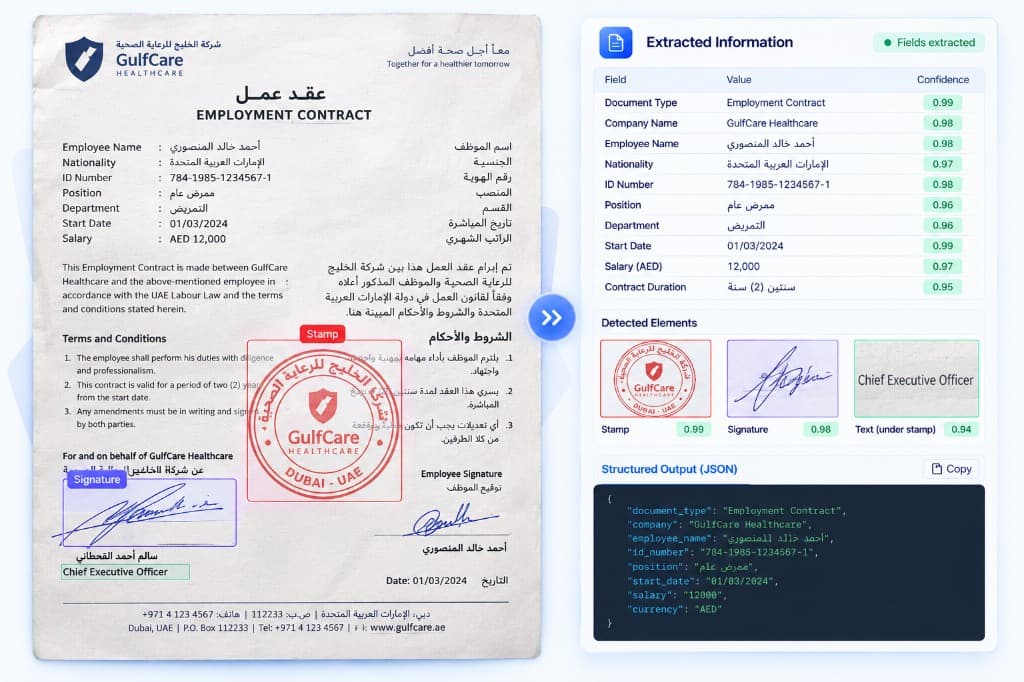
A stamped and signed contract page representing the written Proof of Value agreement and its accuracy threshold
Agreed before day one

Four things signed in writing before the Proof of Value starts

Every argument at the end of an evaluation comes from something that was left vague at the beginning. These four are settled first, in the agreement, in plain language.

Success metric

The accuracy threshold on your documents

A field-level accuracy figure, per document category, measured against ground truth your reviewer adjudicates, with the normalisation rules and the all-fields denominator written out. Both parties sign the definition of correct before either sees a result.

  • Per category, not a single blended number
  • Exact match on normalised values
  • Every schema field in the denominator
Scope

The document set and the volume

The exact categories, the count per category and the volume set used for throughput testing are all named. The set cannot be quietly narrowed later to help the result, and it cannot be widened later to sink it.

  • Typically 300 to 1,000 documents
  • Hard categories explicitly included
  • Separate volume set for throughput
Definition of done

Success criteria beyond accuracy

Accuracy alone does not make a decision. The agreement also states the throughput target, the integration paths to be proven, the review-queue behaviour to be demonstrated and any security controls your team needs evidenced.

  • Pages per hour at peak
  • At least one live integration path
  • Security controls evidenced for your team
Commercials

The conversion price to a full licence

The annual licence figure for the production footprint is fixed before the Proof of Value begins, so a strong result cannot be used to reprice the deal and a weak one cannot be used to discount your way into a bad decision.

  • Licence price fixed in advance
  • Priced by footprint, never per page
  • No renegotiation on a good result
The plan

Week by week, with an owner for every step

A 30 to 45 day window, structured so the accuracy study starts in week two rather than in the last three days.

  1. 1
    Week 0 — before the clock starts

    Scoping, agreement and prerequisites

    One hour with an engineer to fix the document categories, schemas, threshold, throughput target and conversion price, followed by the signed agreement. Your team confirms the environment, GPU access, the named reviewer and the security path our engineers will work through.

  2. 2
    Week 1

    Deploy and integrate

    The bundle is installed on your infrastructure, identity is wired to your OIDC or SAML provider, storage and one live ingest path are connected, and the first documents flow through the pipeline. Air-gapped installs follow the offline runbook from physical media.

  3. 3
    Week 2

    Schemas configured and ground truth adjudicated

    Extraction schemas are configured against your document categories while your reviewer, using our adjudication tooling, establishes the ground truth for the evaluation set. These run in parallel, and the ground truth is settled without reference to any model output.

  4. 4
    Weeks 3 to 4

    Measured accuracy run and throughput test

    The scoring script runs against the adjudicated set and reports per-category, per-field results, along with what would have been routed to review at each confidence threshold. The volume set runs separately to establish pages per hour on your hardware.

  5. 5
    Weeks 5 to 6

    Report, sizing recommendation and decision

    You receive the accuracy report, the throughput measurements, the production sizing recommendation and the integration plan, and we walk your team through all four. Then the threshold is either met or it is not, and the pre-agreed outcome follows.

Checklist

What you provide, and what to have ready before week one

Nothing exotic, but every item on this list has delayed a pilot somewhere. Confirm them during scoping and week one becomes deployment rather than procurement.

Documents

Evaluation set
300 to 1,000 documents across your real categories, deliberately including scans, phone photographs, handwritten forms, stamped pages and faxes.
Volume set
Optional but recommended. A larger unlabelled batch — commonly 10,000 to 100,000 pages — used to measure throughput under realistic load.
Target fields
The fields you need per category, or a sample of the downstream record you are populating. We turn this into formal schemas during week two.

Environment and compute

GPU access
At minimum one current-generation data-centre GPU for a sandbox footprint. Sizing confirms the exact requirement against your document mix during scoping.
Runtime
A Kubernetes namespace or a Docker host on Linux, with the CPU, RAM and local storage confirmed in the sizing note.
Storage
S3-compatible object storage or a mounted filesystem you control, plus a PostgreSQL instance or the bundled one.
Network path
No outbound internet access is required. Inbound access for your own users and systems, and whatever engineer access path your security team approves — including none, for supervised air-gapped installs.

People and access

Named business reviewer
One person with the domain authority to decide what the correct value is on your documents. This is the single most important prerequisite on the list.
Infrastructure contact
Someone who can approve the namespace, the GPU allocation and the identity-provider registration without a monthly change board.
Security reviewer
Optional but sensible. The security pack, image signatures and SBOM are available under NDA for review in parallel with week one.

If any prerequisite is genuinely blocked — no GPU available, no reviewer free until next quarter — say so during scoping. We would rather move the start date than run a Proof of Value that produces a number nobody trusts.

Positioning

Free cloud trial versus a paid on-premise Proof of Value

Free trials are excellent for answering whether a tool is pleasant to use. They are structurally incapable of answering whether it is deployable in a regulated environment at your accuracy and throughput.

Free cloud trial versus a paid on-premise Proof of Value
CriterionFree cloud trialUnpaid vendor pilotDocxIntel Proof of Value
Where your documents are processedVendor cloudVendor or your cloud tenantYour infrastructure, air-gapped if required
Documents you can useWhatever legal will let you uploadrarely the sensitive ones that matterUsually a sanitised subsetYour real production documents
Volume allowanceCapped, commonly a few hundred to a few thousand pagesNegotiated, informalUnmetered on your own compute
Accuracy result you end withYour own impression of some samplesVendor-produced summaryScored against ground truth your reviewer adjudicated
Contractual accuracy thresholdNoneRarelyAgreed in writing before day one
Throughput evidenceNone — shared multi-tenant capacityIndicativeMeasured pages per hour on your hardware
Security review satisfiedThird-party risk assessment still requiredPartiallyReviewed against the deployed system itself
CostFree, then metered per pageFree, with soft conversion pressureFixed fee, conversion price pre-agreed
If the result is disappointingYou stop using itAn extension is proposedYou keep the report and owe nothing further

Where your documents are processed

Free cloud trial
Vendor cloud
Unpaid vendor pilot
Vendor or your cloud tenant
DocxIntel Proof of Value
Your infrastructure, air-gapped if required

Documents you can use

Free cloud trial
Whatever legal will let you uploadrarely the sensitive ones that matter
Unpaid vendor pilot
Usually a sanitised subset
DocxIntel Proof of Value
Your real production documents

Volume allowance

Free cloud trial
Capped, commonly a few hundred to a few thousand pages
Unpaid vendor pilot
Negotiated, informal
DocxIntel Proof of Value
Unmetered on your own compute

Accuracy result you end with

Free cloud trial
Your own impression of some samples
Unpaid vendor pilot
Vendor-produced summary
DocxIntel Proof of Value
Scored against ground truth your reviewer adjudicated

Contractual accuracy threshold

Free cloud trial
None
Unpaid vendor pilot
Rarely
DocxIntel Proof of Value
Agreed in writing before day one

Throughput evidence

Free cloud trial
None — shared multi-tenant capacity
Unpaid vendor pilot
Indicative
DocxIntel Proof of Value
Measured pages per hour on your hardware

Security review satisfied

Free cloud trial
Third-party risk assessment still required
Unpaid vendor pilot
Partially
DocxIntel Proof of Value
Reviewed against the deployed system itself

Cost

Free cloud trial
Free, then metered per page
Unpaid vendor pilot
Free, with soft conversion pressure
DocxIntel Proof of Value
Fixed fee, conversion price pre-agreed

If the result is disappointing

Free cloud trial
You stop using it
Unpaid vendor pilot
An extension is proposed
DocxIntel Proof of Value
You keep the report and owe nothing further

Trial mechanics described here reflect publicly documented free tiers of managed document-parsing and IDP services as of 2026, including credit-capped free plans and 14-day trials of a few hundred to a few thousand pages. Verify against current vendor documentation before comparing.

Compare the platforms in detail
What you keep

Deliverables, the guarantee, and how it converts

Six things exist at the end of a Proof of Value regardless of the decision you make. All of them are yours.

Deliverable

A working deployed instance

DocxIntel running on your infrastructure with your identity provider, your storage and at least one live ingest path connected — not a demo tenancy that expires.

Deliverable

The measured accuracy report

Per-category and per-field results against your adjudicated ground truth, the review-queue volume at each confidence threshold, and a plain account of which of your document types performed worst and why.

Deliverable

A production sizing recommendation

GPU workers, CPU, memory and storage for your target throughput, derived from measured pages per hour on your own document mix, with the resilience options priced separately.

Deliverable

An integration plan

How the output lands in your core systems, where the review queue sits in your operating model, which schemas need work, and what your team has to build versus configure.

Guarantee

The guarantee, in one sentence

If the contracted accuracy threshold on your document set is not met, you keep every deliverable above and owe nothing further — no licence obligation, no extension fee, no conversion.

Next step

Conversion to a licence

Threshold met and you want to proceed: the licence converts at the price fixed before the Proof of Value began, the evaluated deployment becomes the licensed deployment, and the footprint in the order is what renews annually.

How the licence is priced →

Questions asked before committing to a Proof of Value

The practical objections, answered by the people who would run it.

Because it is not a trial — it is a deployment. Engineers install DocxIntel inside your infrastructure, configure schemas against your document types, run a measured accuracy study on ground truth your reviewer adjudicates and hand back a sizing recommendation and an integration plan. Free pilots are staffed accordingly: they get whoever is spare, they slip, and they end without a number anyone will sign. A fixed fee buys named engineers, a fixed end date and a written result.

You keep the measured accuracy report, the per-category breakdown and the sizing recommendation, and you owe nothing further — no licence commitment, no extension fee, no conversion. The threshold is written into the agreement before the work starts, measured against the document set named in that agreement, so whether it was met is a matter of arithmetic rather than interpretation.

Typically between 300 and 1,000 documents spanning your real categories, plus a larger unlabelled volume set if you want throughput measured under load. What matters far more than the count is that the set includes the documents your current process struggles with — the phone photographs, the handwritten Arabic forms, the stamped invoices and the third-generation faxes. A set of clean native PDFs produces a flattering number and a worthless decision.

No. DocxIntel is deployed inside your infrastructure and the models run on your GPUs, so the evaluation set never leaves your perimeter — including in a fully air-gapped install, where the bundle arrives on physical media. Our engineers work through whatever access path your security team approves, and if that path is a supervised session on your premises with no remote access at all, the Proof of Value still runs.

Yes, and most first deployments do. The evaluation sandbox footprint is a single-node install with one GPU worker, isolated from production systems, which is enough to measure accuracy and to establish a throughput baseline. Moving from sandbox to production later is a footprint change, not a reimplementation — the same containers, models and configuration promote across.

The conversion price is fixed in the Proof of Value agreement before day one, so a good result cannot be used to reprice the deal. If the threshold is met and you proceed, the deployment you evaluated becomes the deployment you license at that price. If your footprint has grown in the meantime — a second environment, more GPU workers, high availability — the additional capacity is quoted against the same published price drivers you saw during sizing.

Keep reading

Accuracy benchmark→The metric definition, methodology and per-category results the threshold is built on.Pricing→The fixed annual licence, the price drivers, and the arithmetic against per-page metering.Deployment models→Evaluation sandbox, air-gapped, private cloud or managed single-tenant.Security posture→The controls your security team will review during week one, and the pack available under NDA.Sizing and throughput→How measured pages per hour become a production sizing recommendation.What's in the box→Every container, model bundle and dependency installed during week one.

Book the scoping call.

One hour with an engineer produces the document set, the schemas, the accuracy threshold, the fixed fee and the licence conversion price — all in writing before anything is deployed.

Start a Proof of Value
Read the accuracy methodology
  • No per-page metering
  • Runs in your environment
  • Written accuracy threshold
DocxIntel Logo

A product of BizfyLabs

Document intelligence that never leaves your building. Analyse, identify, classify, map, modify and ask — inside your own infrastructure.

BizfyLabs on LinkedInDocxIntel documentationBizfyLabs

Product

  • Capabilities
    • Analyse
    • Identify
    • Classify
    • Map
    • Modify
    • Ask
  • Accuracy benchmark
  • Pricing
  • Proof of Value

Technical

  • Deployment models
  • Reference architectures
  • Sizing & throughput
  • What's in the box
  • Security posture
  • Model licences
  • Documentation
  • API reference

Solutions

  • All industries
  • Insurance & TPAs
  • Healthcare
  • Banking & finance
  • Government
  • Legal
  • Energy & logistics

Compare

  • Compare approaches
  • LlamaParse alternative
  • Docsumo alternative
  • On-premise document AI

Company

  • About DocxIntel
  • FAQ
  • Partners
  • BizfyLabs
  • Careers
  • Contact

© 2026 BizfyLabs FZC LLC. All rights reserved.

DocxIntel™ is a product of BizfyLabs FZC LLC.

  • Privacy Policy·
  • Terms of Service·
  • Data Processing Addendum·
  • Acceptable Use·
  • Model Licences·
  • Security·
  • Cookies

Registered in the United Arab Emirates. Delivery partner: Bizfy Solutions LLP, Indore, India.

DocxIntel