DocxIntel home
DocxIntel, a product of BizfyLabs
by
BizfyLabs
  • Capabilities
    • Analyse

      Resolve layout, reading order, tables and handwriting

    • Identify

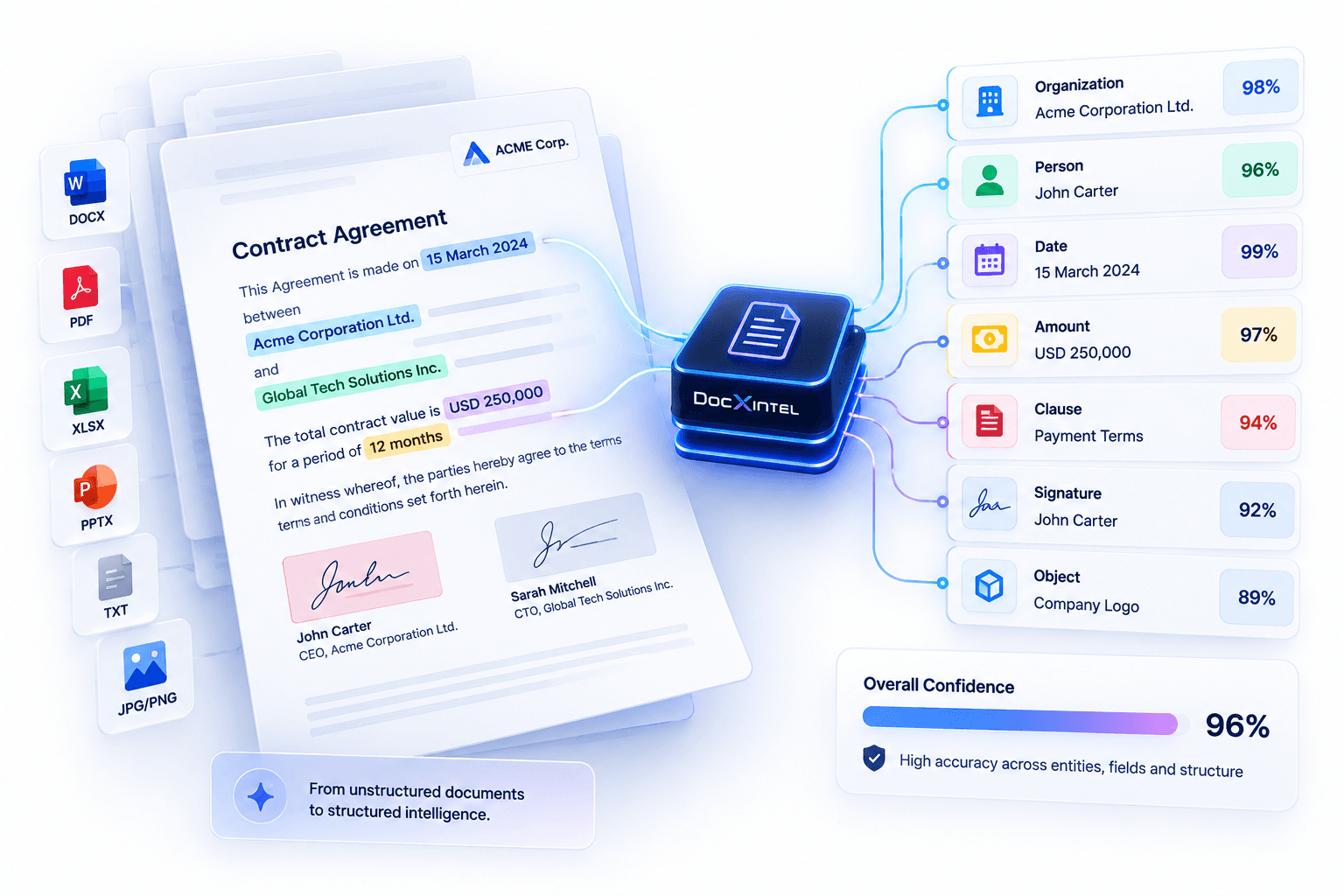
      Pull entities, fields and clauses with coordinates

    • Classify

      Sort document types and split multi-page packets

    • Map

      Link and reconcile entities across your estate

    • Modify

      Redact, mask and transform documents safely

    • Ask

      Query your documents and get cited answers

    • All six capabilities, one platform→
  • Deployment
  • Accuracy
  • Industries
    • Banking & Financial Services

      Statements, KYC files, and financial filings

    • Insurance

      Claims, policies, and underwriting documents

    • Government & Public Sector

      Records, correspondence, and regulatory filings

    • Healthcare

      Patient records, referrals, and lab reports

    • Legal & Compliance

      Contracts, filings, and case documentation

    • Energy & Utilities

      Engineering documents, contracts, and reports

    • Every regulated industry we serve→
  • Pricing
  • Docs
Book a Demo
Home
DocXIntel

Menu

    • All capabilities
    • Analyse
    • Identify
    • Classify
    • Map
    • Modify
    • Ask
    • All industries
    • Banking & Financial Services
    • Insurance
    • Government & Public Sector
    • Healthcare
    • Legal & Compliance
    • Energy & Utilities
    • Deployment models
    • Reference architectures
    • Sizing & throughput
    • What's in the box
    • Security posture
    • Documentation
    • Accuracy benchmark
    • Pricing
    • Proof of Value
    • Compare
    • About
    • FAQ
    • Contact Us
Industry — Healthcare

Healthcare document processing that keeps PHI inside the hospital network.

Hospitals, clinics and payers hold the documents least permitted to travel and hardest to read: handwritten prescriptions, faxed lab reports, discharge summaries, pre-approval forms. DocxIntel reads them on your own hardware, with the models in the bundle and no external API in the path.

  • PHI never leaves
  • Handwriting-native
  • Runs air-gapped
  • No per-page charge
Book a clinical documents walkthrough
Review the security architecture
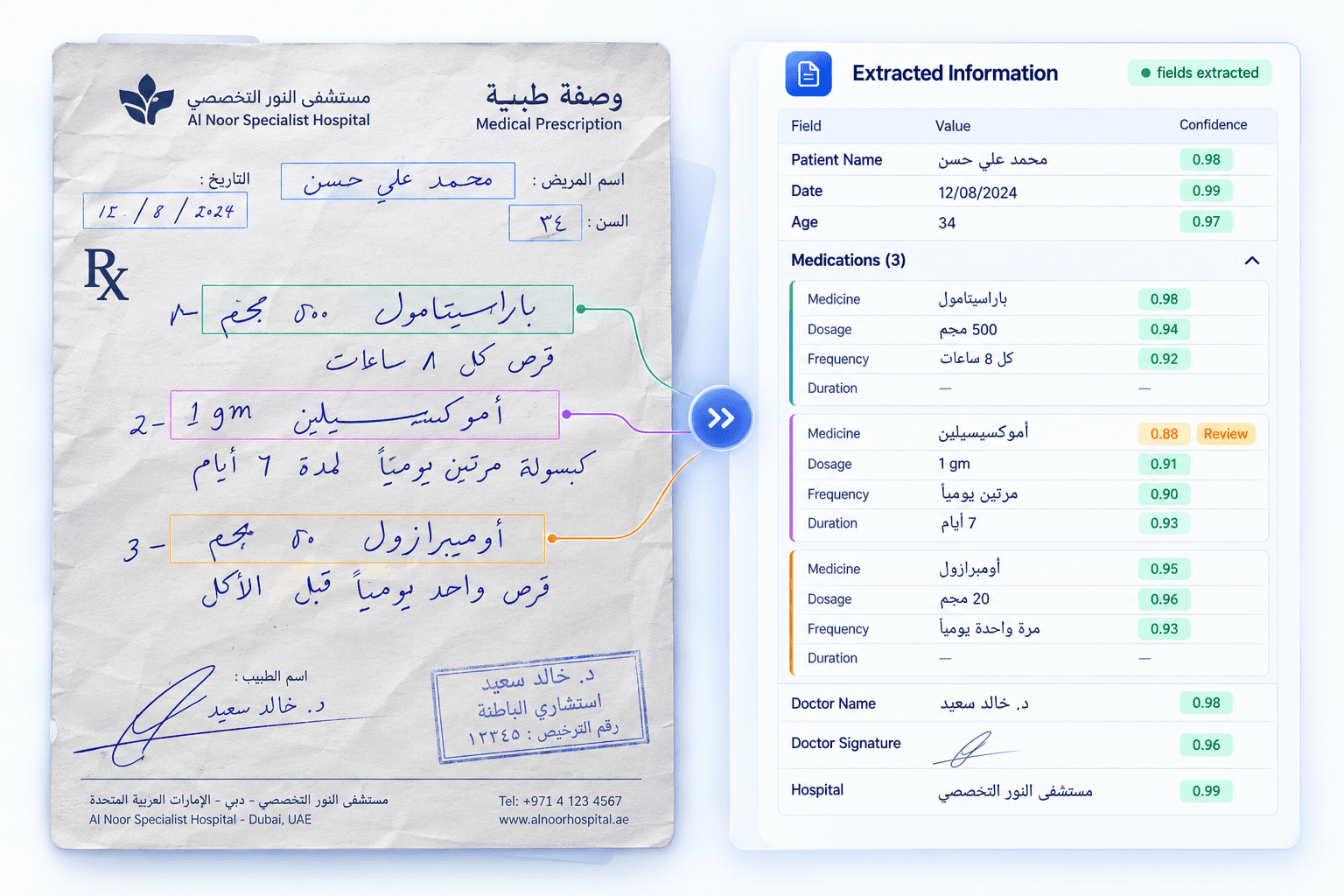
A handwritten prescription being read on-premise with medication and dosage fields extracted and confidence-scored
0 bytes
PHI leaving your network
air-gapped installs
99%
Field-level accuracy
on the published benchmark set
AR + EN
Handwriting recognised
including mixed-script pages
Unmetered
Patient pages processed
fixed annual licence

Accuracy is measured field-by-field against a human-adjudicated ground truth, not character-by-character. Medication, dosage and identifier fields are held to tighter confidence thresholds than descriptive text, and your own threshold is agreed in writing before the Proof of Value begins.

What it processes

The clinical and administrative documents that still move on paper

Hospitals digitised their systems long before they digitised their paper. Prescriptions are still handwritten, referrals still arrive by fax, and pre-approvals are still assembled by hand from four different documents.

Prescription digitisation

Handwritten prescriptions are read into structured medication, dosage, frequency and duration fields, with the prescribing clinician and date captured alongside. Ambiguous entries are flagged, never guessed.

  • Handwritten Arabic and English
  • Dosage and frequency parsing
  • Safety-critical field thresholds

Lab and diagnostic reports

Analyte names, values, units and reference ranges are recovered from tabular lab reports, including faxed and multi-generation copies where the table rules have half disappeared.

  • Borderless and ruled result tables
  • Units and reference ranges
  • Multi-generation fax recovery

Discharge summaries

Admission and discharge dates, diagnoses, procedures performed, length of stay and discharge medication are extracted from long-form narrative summaries.

  • Narrative to structured fields
  • Procedure and diagnosis capture
  • Follow-up instruction extraction

Insurance pre-approval packs

Pre-authorisation forms are assembled and checked for completeness against the payer requirement before submission, so packs come back for clinical reasons rather than missing pages.

  • Checklist completeness checks
  • Payer form field mapping
  • Supporting document assembly

Referrals and consent forms

Referral letters, consent forms and intake paperwork are classified and indexed, including signature and checkbox state, so the chart is complete before the appointment starts.

  • Signature and date detection
  • Checkbox and tick-box state
  • Specialty and urgency routing

Coding and record consolidation

Source documents for DRG and clinical coding are indexed and cited, and scattered paper is consolidated against the right patient identity across documents that spell the name three different ways.

  • Cited coding source documents
  • Cross-document identity matching
  • Archive backfile digitisation
End to end

An insurance pre-approval, assembled and checked before it leaves the hospital.

Pre-authorisation is where clinical time is lost to administration. The pack is rejected for a missing page, resubmitted two days later, and the patient waits. Every step below runs inside your network.

  • The clinician submits a handwritten request, a diagnostic report and the patient insurance card as scans or photographs
  • Pages are quality-corrected, classified and attached to the correct patient identity across inconsistent name spellings
  • Diagnosis, procedure, clinician, dates and policy details are extracted with page and bounding-box provenance on every value
  • The pack is checked against the payer checklist for that procedure, and missing or expired documents are named specifically
  • Medication and dosage fields below the safety threshold are routed to a pharmacist queue rather than submitted on trust
  • The completed pack and its structured fields are written back into the pre-authorisation queue in your own systems

Nothing in this sequence involves an external API call, which is what makes it viable under a data-localisation requirement rather than merely fast.

See how field identification works
Clinical fields identified from a pre-approval pack with confidence scores and source coordinates shown
Rollout

How a hospital deployment actually starts

One department, one document type, measured on your own records before anything else is discussed.

  1. 1
    Step 1

    Choose the department losing the most time to paper

    Usually outpatient pharmacy, the pre-authorisation desk or medical records. We ask for the documents your staff find hardest — the illegible prescription, the fourth-generation faxed lab report — because those decide whether the accuracy number survives production.

  2. 2
    Step 2

    Clear it with information governance first

    Because processing happens inside your network, the review is about internal access control and audit logging rather than cross-border transfer. Data-flow documentation and deployment evidence are provided for your assessors before installation, not after.

  3. 3
    Step 3

    Install inside the clinical network

    Containers and open-weight models are deployed on your hardware in the segment your policy requires, air-gapped or private cloud. Your infrastructure team holds root and the encryption keys, and no patient record is ever visible to us.

  4. 4
    Step 4

    Configure the field schema and safety thresholds

    Document types, field lists and validation rules are configured on your own forms. Medication, dosage and patient-identifier fields are set to stricter confidence thresholds so anything doubtful lands in a human queue by design.

  5. 5
    Step 5

    Measure with your own clinicians adjudicating

    Accuracy is adjudicated field-by-field by your pharmacists, coders or records staff. The report shows per-field accuracy, the confidence distribution and the review load you would actually staff. Miss the agreed threshold and you keep the report and owe nothing further.

  6. 6
    Step 6

    Expand to the backfile and the rest of the estate

    Adding a second department, a second clinic or a decade of archived paper records is a configuration change and some GPU time. The licence does not move because the page count did.

Reference

Healthcare document types and the fields extracted from each

An indicative schema. The final field list is agreed against your own forms and your own payer requirements during the Proof of Value.

Clinical documents

Handwritten prescription
Patient name and identifier, prescriber name and licence, date, medication, strength, dosage, frequency, duration, quantity, refills, signature
Lab and diagnostic report
Patient identifier, specimen and collection date, ordering clinician, analyte names, values, units, reference ranges, abnormal flags, verifying pathologist
Discharge summary
Admission and discharge dates, admitting and final diagnosis, procedures performed, length of stay, discharge medication, follow-up plan, consultant name
Referral letter
Referring and receiving clinician, specialty, urgency, reason for referral, relevant history, investigations already performed, date


Administrative and payer documents

Insurance pre-approval form
Member and policy number, payer and plan, requested procedure and codes, clinical justification, estimated cost, requesting clinician, submission date
Consent form
Patient and witness names, procedure consented to, risks acknowledged, checkbox and initial state, signature presence, date and time
Insurance card and identity documents
Member name and number, payer, plan and network, validity dates, Emirates ID number, date of birth, nationality
Coding source documents
Diagnoses and procedures with the document, page and line each was taken from, service dates, clinician identifiers, supporting narrative citations

Handling and provenance

Accepted inputs
Scanned and native PDF, JPEG, PNG, multi-page TIFF including Group 3/4 fax, HEIC phone photographs, DOCX and XLSX
Attached to every field
Page number, bounding-box coordinates, confidence score and a stable element identifier that survives re-runs
Retention
Governed entirely by your own storage and records policy; DocxIntel holds no copy of any patient document

Regulatory references on this page are provided as evaluation context, not legal advice. Confirm the obligations that apply to your facility with your own compliance and information-governance functions.

Positioning

Clinical document processing: on-premise against metered cloud IDP

Cloud IDP platforms read medical forms well. The problem is structural: a metered service has to receive the page before it can read it, and the page is a patient record.

Clinical document processing: on-premise against metered cloud IDP
CriterionMetered cloud IDPVendor BYOC tierDocxIntel
Where patient documents are readVendor cloudYour cloud tenantYour infrastructure, including bare metal
Fits a health data-localisation requirementDifficult to evidenceRegion-dependentProcessing stays in your facility
Works on an isolated clinical networkNot availableRequires connectivitySupported by default
Parsed PHI cached outside your controlCommonly cached by defaultdocumented at 48 hours on some servicesVendor-managedNothing to cache
Digitising a decade of paper recordsCharged per page, every pageCharged per page, every pageNo incremental charge
Illustrative cost at 100,000 pages a monthRoughly $15,000 to $67,500 a yearlist-rate arithmetic at $0.0125 to $0.05625 per pageStill metered per pageFixed annual licencesized by deployment footprint
Handwritten Arabic clinical notesBest-effortBest-effortFirst-class
Self-hosting available onNo planTop enterprise tier onlyEvery licence

Where patient documents are read

Metered cloud IDP
Vendor cloud
Vendor BYOC tier
Your cloud tenant
DocxIntel
Your infrastructure, including bare metal

Fits a health data-localisation requirement

Metered cloud IDP
Difficult to evidence
Vendor BYOC tier
Region-dependent
DocxIntel
Processing stays in your facility

Works on an isolated clinical network

Metered cloud IDP
Not available
Vendor BYOC tier
Requires connectivity
DocxIntel
Supported by default

Parsed PHI cached outside your control

Metered cloud IDP
Commonly cached by defaultdocumented at 48 hours on some services
Vendor BYOC tier
Vendor-managed
DocxIntel
Nothing to cache

Digitising a decade of paper records

Metered cloud IDP
Charged per page, every page
Vendor BYOC tier
Charged per page, every page
DocxIntel
No incremental charge

Illustrative cost at 100,000 pages a month

Metered cloud IDP
Roughly $15,000 to $67,500 a yearlist-rate arithmetic at $0.0125 to $0.05625 per page
Vendor BYOC tier
Still metered per page
DocxIntel
Fixed annual licencesized by deployment footprint

Handwritten Arabic clinical notes

Metered cloud IDP
Best-effort
Vendor BYOC tier
Best-effort
DocxIntel
First-class

Self-hosting available on

Metered cloud IDP
No plan
Vendor BYOC tier
Top enterprise tier only
DocxIntel
Every licence

Cost figures are our own arithmetic on publicly published list rates as of 2026, not vendor quotations. Caching behaviour and self-hosting availability reflect publicly documented behaviour of metered parsing services. Verify against current vendor documentation before making a decision.

Compare the options in detail

Questions hospital CIOs and information governance ask

The questions that decide whether clinical document automation is approvable at all, answered without hedging.

No. The models ship inside the deployment bundle and run on your own GPUs, so a prescription is read by software sitting in the same data centre as the patient record it belongs to. There is no external inference endpoint, no telemetry beacon and no fallback cloud call when confidence is low — an air-gapped install behaves identically to a connected one.

The requirement that health data generated in the UAE stays in the UAE is the reason on-premise document processing exists in this sector. Because DocxIntel is infrastructure you install and operate, the processing location is your own facility and there is no cross-border transfer to justify. The compliance position remains yours to certify; we supply the deployment evidence, data-flow documentation and audit logs your assessors ask for.

Handwriting is a first-class input rather than a discarded layer, in Arabic and English, including mixed scripts on the same page and Arabic-Indic numerals in dosages. Low-confidence entries are flagged with their coordinates instead of being silently guessed, so a pharmacist reviews the 2% that are genuinely ambiguous rather than re-keying all 100%. Medication and dosage fields are treated as safety-critical and given tighter thresholds than descriptive text.

Output is structured JSON, tabular exports or direct API responses inside your own environment, so it can be mapped into the hospital information system, the EMR or the pre-authorisation queue you already run. DocxIntel is the reading layer beneath those systems, not another interface for clinical staff to learn.

Not per page. A fixed annual licence sized by deployment footprint means a busy month in outpatients does not produce an invoice, and digitising a decade of paper records is a scheduling question rather than a budget approval. Per-page metering makes exactly the projects with the most clinical value the most expensive ones to attempt.

It supplies the source data that coding depends on: diagnoses, procedures, dates, clinician identifiers and the documents each value came from, with page and bounding-box provenance attached. Coders and auditors work from cited source documents rather than re-reading the chart, and a retrospective audit can trace any code back to the exact line on the exact page.

Keep reading

All industries→The six regulated sectors DocxIntel is built for, and the constraint they share.Insurance→Claim packet auto-split, policy reconciliation and reimbursement processing.Government→Sovereign, air-gapped digitisation of citizen services and public archives.Analyse→How handwriting, faxed tables and photographed pages are resolved before extraction.Security architecture→Isolation, audit logging and key handling — the controls your assessors will ask about.Deployment models→Air-gapped, private cloud, managed single-tenant or evaluation sandbox.

Start with the prescriptions your pharmacy re-keys by hand.

Thirty to forty-five days, fixed fee, deployed inside your clinical network on your own records. The accuracy threshold and the conversion price are both agreed in writing before we begin.

Talk to an engineer
How the Proof of Value works
  • No per-page metering
  • Runs in your environment
  • Written accuracy threshold
DocxIntel Logo

A product of BizfyLabs

Document intelligence that never leaves your building. Analyse, identify, classify, map, modify and ask — inside your own infrastructure.

BizfyLabs on LinkedInDocxIntel documentationBizfyLabs

Product

  • Capabilities
    • Analyse
    • Identify
    • Classify
    • Map
    • Modify
    • Ask
  • Accuracy benchmark
  • Pricing
  • Proof of Value

Technical

  • Deployment models
  • Reference architectures
  • Sizing & throughput
  • What's in the box
  • Security posture
  • Model licences
  • Documentation
  • API reference

Solutions

  • All industries
  • Insurance & TPAs
  • Healthcare
  • Banking & finance
  • Government
  • Legal
  • Energy & logistics

Compare

  • Compare approaches
  • LlamaParse alternative
  • Docsumo alternative
  • On-premise document AI

Company

  • About DocxIntel
  • FAQ
  • Partners
  • BizfyLabs
  • Careers
  • Contact

© 2026 BizfyLabs FZC LLC. All rights reserved.

DocxIntel™ is a product of BizfyLabs FZC LLC.

  • Privacy Policy·
  • Terms of Service·
  • Data Processing Addendum·
  • Acceptable Use·
  • Model Licences·
  • Security·
  • Cookies

Registered in the United Arab Emirates. Delivery partner: Bizfy Solutions LLP, Indore, India.

DocxIntel