DocxIntel home
DocxIntel, a product of BizfyLabs
by
BizfyLabs
  • Capabilities
    • Analyse

      Resolve layout, reading order, tables and handwriting

    • Identify

      Pull entities, fields and clauses with coordinates

    • Classify

      Sort document types and split multi-page packets

    • Map

      Link and reconcile entities across your estate

    • Modify

      Redact, mask and transform documents safely

    • Ask

      Query your documents and get cited answers

    • All six capabilities, one platform→
  • Deployment
  • Accuracy
  • Industries
    • Banking & Financial Services

      Statements, KYC files, and financial filings

    • Insurance

      Claims, policies, and underwriting documents

    • Government & Public Sector

      Records, correspondence, and regulatory filings

    • Healthcare

      Patient records, referrals, and lab reports

    • Legal & Compliance

      Contracts, filings, and case documentation

    • Energy & Utilities

      Engineering documents, contracts, and reports

    • Every regulated industry we serve→
  • Pricing
  • Docs
Book a Demo
Home
DocXIntel

Menu

    • All capabilities
    • Analyse
    • Identify
    • Classify
    • Map
    • Modify
    • Ask
    • All industries
    • Banking & Financial Services
    • Insurance
    • Government & Public Sector
    • Healthcare
    • Legal & Compliance
    • Energy & Utilities
    • Deployment models
    • Reference architectures
    • Sizing & throughput
    • What's in the box
    • Security posture
    • Documentation
    • Accuracy benchmark
    • Pricing
    • Proof of Value
    • Compare
    • About
    • FAQ
    • Contact Us
Industry — Energy and logistics

Energy and logistics document processing built for documents photographed in the field.

Operators, utilities and logistics businesses run on paper that never sees a scanner: creased delivery notes photographed at a gate, handwritten inspection sheets, stamped bills of lading, contractor invoices. DocxIntel reads them on your own infrastructure, including at sites with no connectivity at all.

  • Phone photos as normal input
  • Works offline at remote sites
  • Three-way matching
  • No per-page charge
Book a field documents walkthrough
See the accuracy benchmark
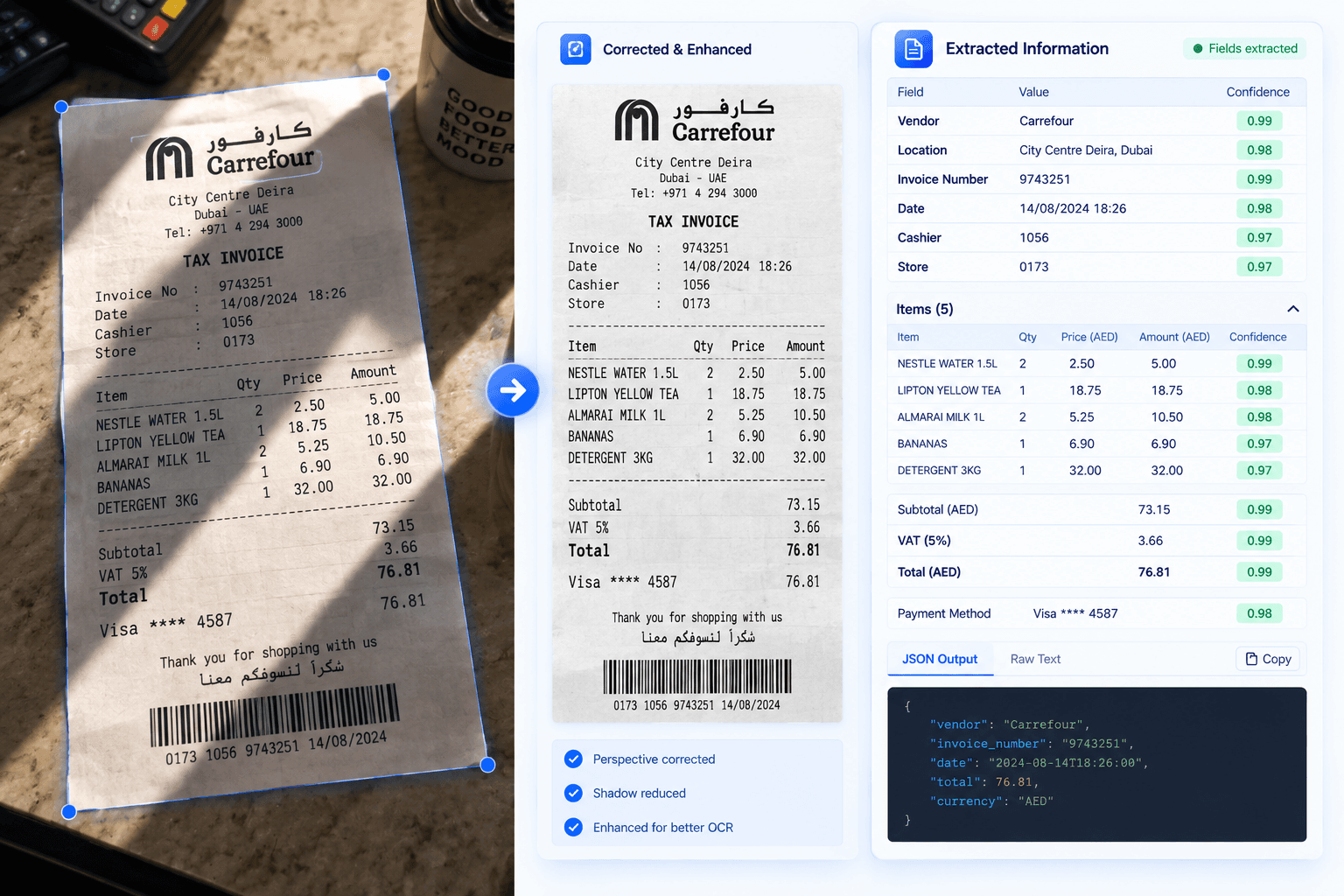
A creased receipt photographed on a phone in poor light, with fields extracted and confidence-scored
Phone photos
Treated as normal input
glare, skew, creases, shadow
Offline
Operation at remote sites
models load locally
99%
Field-level accuracy
on the published benchmark set
Unmetered
Field pages processed
fixed annual licence

Accuracy is measured field-by-field against a human-adjudicated ground truth, not character-by-character. The published benchmark mix includes photographed and degraded pages, and your own threshold is agreed in writing on your own field documents before the Proof of Value begins.

What it processes

The field and supply-chain documents that break other tools

A delivery note that has been folded into a pocket, rained on and photographed at dusk is not an edge case in this sector. It is Tuesday.

Three-way invoice matching

Purchase orders, goods receipts and contractor invoices are read and compared line by line, with disagreements raised as named exceptions rather than a match percentage.

  • Line-level quantity and rate checks
  • Tax and total reconciliation
  • Named exception reporting

Proof of delivery from phone photos

Delivery notes and proof-of-delivery photographs captured by drivers and gate staff are quality-corrected and read, including signatures, stamps and handwritten quantities.

  • Glare, skew and crease recovery
  • Signature and stamp detection
  • Handwritten quantity capture

Bills of lading and shipping documents

Bills of lading, manifests, certificates of origin and customs paperwork are extracted with container, seal, weight and consignee details intact.

  • Container and seal numbers
  • Consignee and notify party
  • Weight and volume reconciliation

Inspection and maintenance reports

Existing field forms are read as they are: handwritten sections, ticked checkboxes, annotated sketches, meter values and attached photographs.

  • Checkbox and tick-box state
  • Handwritten readings and notes
  • Per-asset indexing

HSE incident reports and meter readings

Incident reports, permits to work and manual meter readings are captured into structured records so trends and overdue actions become queryable.

  • Incident classification and dates
  • Corrective action tracking
  • Meter value and timestamp capture

Engineering drawings and datasheets

Title blocks, revision histories, tag numbers and datasheet parameters are extracted and cross-referenced, so drawings and specifications can be reconciled against each other.

  • Title block and revision capture
  • Tag and equipment numbers
  • Datasheet parameter tables
End to end

A contractor invoice matched to a photographed delivery note and a purchase order.

This is the reconciliation that holds up payment runs and creates contractor disputes. Every step runs inside your own environment, including at sites where the connection is unreliable.

  • A driver photographs the signed delivery note at the gate; the image is creased, angled and half in shadow
  • The page is deskewed, dewarped and glare-corrected before recognition, and the handwritten delivered quantity is read with a confidence score
  • The contractor invoice arrives separately as a scan with a company stamp printed across the total, which is separated from the figure beneath it
  • The purchase order is pulled from your ERP and the three documents are matched line by line: item, quantity, unit rate, tax, total
  • Mismatches become named exceptions — short delivery, rate variance, duplicate invoice number — each cited to a page and a bounding box
  • Matched invoices flow to payment and exceptions flow to a review queue, both written back into the systems your team already uses

At an offshore or remote site the same pipeline runs locally, so a lost satellite link delays synchronisation rather than stopping recognition.

See how cross-document mapping works
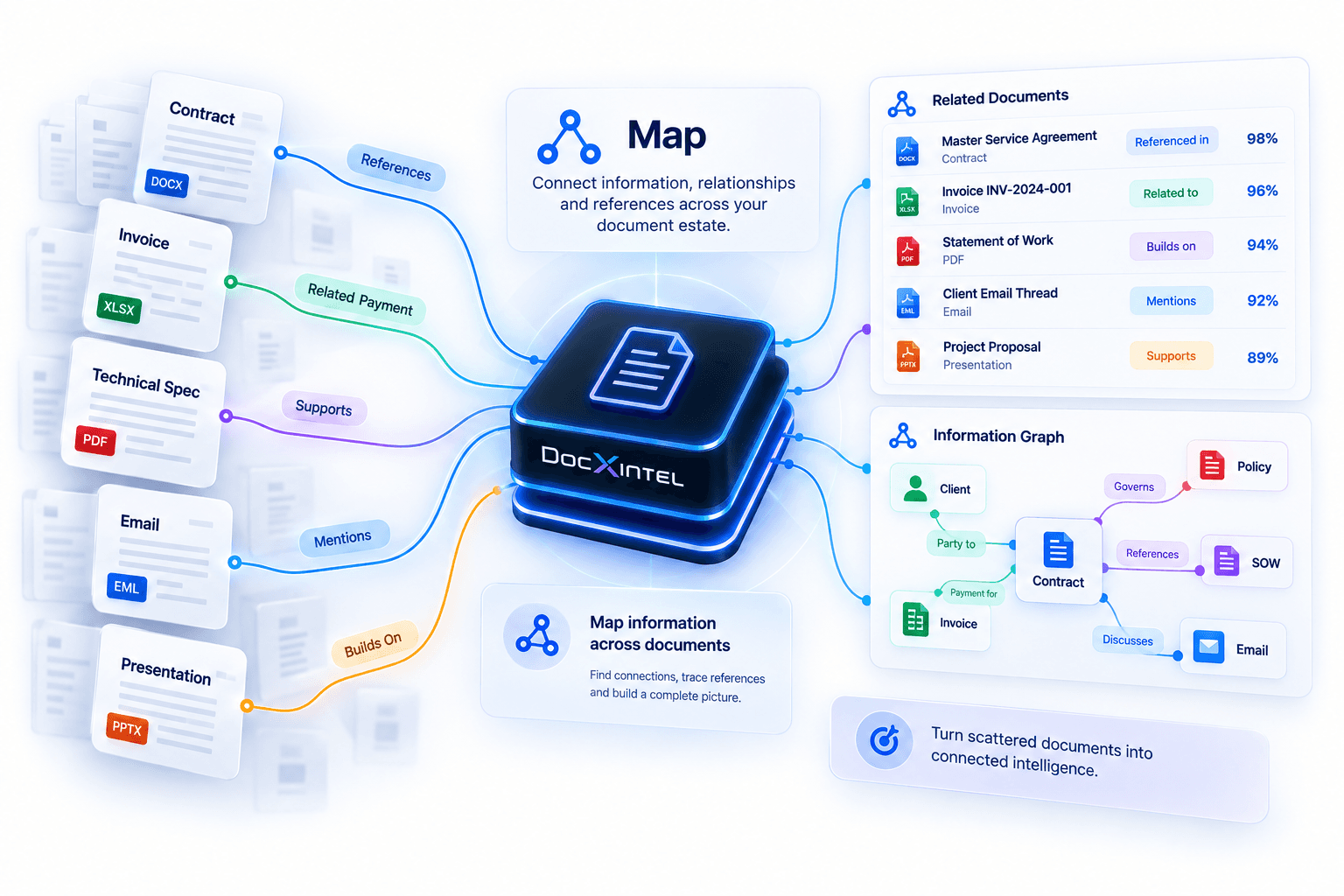
A purchase order, delivery note and contractor invoice reconciled line by line with mismatches highlighted
Rollout

How an energy or logistics deployment actually starts

One document flow, one site or terminal, measured on the images your field teams actually capture.

  1. 1
    Step 1

    Pick the document flow that delays payment

    Usually contractor invoice matching, proof-of-delivery capture or inspection report digitisation. We ask specifically for the photographs your current tool rejects, because a sample of clean scans produces an accuracy number that will not survive the first week in the field.

  2. 2
    Step 2

    Decide where processing runs

    Centrally in your data centre, or locally at terminals and remote sites that cannot depend on a link. Both are supported by the same bundle, and the choice is about connectivity and latency rather than licensing tier.

  3. 3
    Step 3

    Install inside your own environment

    Containers and open-weight models are deployed on your hardware — air-gapped, private cloud or managed single-tenant. Your team holds root, the keys and the change window, and no site document is visible to us.

  4. 4
    Step 4

    Configure matching rules against your existing forms

    Document types, field schemas, tolerance rules for quantity and rate variance and per-contractor form variants are configured directly. Your field forms do not have to be redesigned to be readable.

  5. 5
    Step 5

    Measure on real field captures

    Your own accounts payable and inspection teams adjudicate field-by-field, and the report shows per-field accuracy, confidence distribution and the exception rate you would staff for. Miss the agreed threshold and you keep the report and owe nothing further.

  6. 6
    Step 6

    Roll out across sites and back over the archive

    Adding sites, contractors or a year of historical delivery notes for an audit is a configuration change and some GPU time. The licence does not move because the shipping schedule got busy.

Reference

Energy and logistics document types and the fields extracted from each

An indicative schema. The final field list is agreed against your own forms, contractor variants and tolerance rules during the Proof of Value.

Supply chain and commercial documents

Bill of lading
B/L number, shipper, consignee and notify party, vessel and voyage, ports of loading and discharge, description of goods, container and seal numbers, gross weight, on-board date
Delivery note and proof of delivery
Delivery note number, purchase order reference, delivery date and time, site or gate, item lines, delivered quantities, receiver name, signature and stamp presence
Contractor invoice
Invoice number and date, contractor name and trade licence, purchase order reference, item and service lines, quantities, unit rates, VAT, retention, total payable
Purchase order
PO number and date, supplier, delivery site and required date, item lines with quantities and agreed rates, incoterms, payment terms, approval signatures

Field and technical documents

Inspection and maintenance report
Asset and tag number, site and location, inspection date, inspector name and certification, checklist responses, measured values, defects raised, photographs referenced, sign-off
Meter reading sheet
Meter or asset identifier, reading value and units, previous reading, reading date and time, reader identity, anomaly notes, handwritten corrections
HSE incident report
Incident reference, date, time and location, incident category and severity, people involved, immediate actions, root cause notes, corrective actions and owners, reporting supervisor
Engineering drawing and datasheet
Drawing number, title, revision and revision date, discipline, scale, tag numbers referenced, datasheet parameters with values and units, approval signatures


Image handling and provenance

Image recovery applied first
Deskew, dewarp, perspective correction, glare and shadow suppression, contrast normalisation, crease and fold handling, multi-generation photocopy recovery
Accepted inputs
HEIC and JPEG phone captures, scanned and native PDF, PNG, multi-page TIFF including Group 3/4 fax, DOCX and XLSX
Attached to every field
Page number, bounding-box coordinates, confidence score and a stable element identifier that survives re-runs
Remote site operation
Models load from local storage; recognition never requires an outbound call, so a lost link delays synchronisation rather than processing

Format and image-quality coverage in a specific deployment is confirmed in writing during the Proof of Value against your actual field captures, not against a generic list.

Positioning

Field document processing: on-premise against metered cloud IDP

Cloud IDP platforms perform well on clean scans. The difficulty in this sector is that clean scans are the minority, and the pages that matter most are the ones captured on a phone at a gate.

Field document processing: on-premise against metered cloud IDP
CriterionMetered cloud IDPManual data entryDocxIntel
Where documents are readVendor cloudBack officeYour infrastructure, including at site
Works at a site with no connectivityNoOnly after transportYes, models load locally
Creased, angled, glare-affected phone photosFrequently routed to reviewReadable but slowCorrected before recognition
Existing field forms usable as they areOften needs template workYesTemplate-free
Cost of a busy shipping quarterScales with page volumeScales with overtimeNo change to the licence
Illustrative cost at 100,000 pages a monthRoughly $15,000 to $360,000 a yearlist-rate arithmetic at $0.0125 to $0.30 per pageHeadcount-dependentFixed annual licencesized by deployment footprint
Re-running a year of delivery notes for a disputeCharged again per pageNot feasibleNo incremental charge
Engineering drawings and contract rates exposedSent to the vendorStays internalStays internal

Where documents are read

Metered cloud IDP
Vendor cloud
Manual data entry
Back office
DocxIntel
Your infrastructure, including at site

Works at a site with no connectivity

Metered cloud IDP
No
Manual data entry
Only after transport
DocxIntel
Yes, models load locally

Creased, angled, glare-affected phone photos

Metered cloud IDP
Frequently routed to review
Manual data entry
Readable but slow
DocxIntel
Corrected before recognition

Existing field forms usable as they are

Metered cloud IDP
Often needs template work
Manual data entry
Yes
DocxIntel
Template-free

Cost of a busy shipping quarter

Metered cloud IDP
Scales with page volume
Manual data entry
Scales with overtime
DocxIntel
No change to the licence

Illustrative cost at 100,000 pages a month

Metered cloud IDP
Roughly $15,000 to $360,000 a yearlist-rate arithmetic at $0.0125 to $0.30 per page
Manual data entry
Headcount-dependent
DocxIntel
Fixed annual licencesized by deployment footprint

Re-running a year of delivery notes for a dispute

Metered cloud IDP
Charged again per page
Manual data entry
Not feasible
DocxIntel
No incremental charge

Engineering drawings and contract rates exposed

Metered cloud IDP
Sent to the vendor
Manual data entry
Stays internal
DocxIntel
Stays internal

Cost figures are our own arithmetic on publicly published list rates as of 2026 — roughly $0.0125 per page for agentic cloud parsing and around $0.30 per page on a usage-based IDP growth plan — not vendor quotations. Verify against current vendor documentation before making a decision.

Compare the options in detail

Questions operations and finance teams ask

The objections that come up once someone has actually seen the photographs the field sends in, answered without hedging.

It is the input DocxIntel was built to survive. Deskew, dewarp, perspective correction, glare suppression and contrast normalisation run before recognition, so a creased delivery note photographed on a bonnet is treated as a normal document rather than an exception. This is the failure mode that sends most extraction tools to manual review, and it is where the accuracy difference actually shows up.

Yes. The models load from local storage, so an installation at a terminal, refinery or offshore facility keeps working when the link to head office does not. Deployments can also run centrally with sites uploading when a connection returns — the point is that recognition never depends on an outbound call to a vendor endpoint.

The purchase order, the goods receipt or delivery note and the contractor invoice are read as structured documents, then compared line by line: item, quantity, unit rate, delivered quantity, tax and total. Disagreements are raised as named exceptions with the page and coordinates on each side, so accounts payable reviews a specific mismatch rather than three PDFs in three systems.

No. DocxIntel is template-free, so it does not require your inspection forms to be reissued in a machine-readable layout. Existing forms, including handwritten sections, ticked checkboxes, annotated sketches and attached photographs, are read as they are — which matters because field forms change slowly and often differ per site or per contractor.

Nothing leaves. Engineering drawings, site documents and contractor commercial terms are exactly the material an operator is least willing to expose, and on an air-gapped install there is no outbound path at all. Output is written back into your ERP, maintenance system or document management system inside your own environment.

As a fixed annual licence sized by deployment footprint, never per page. Logistics and field volumes spike with the schedule and the turnaround season, and per-page metering makes a busy quarter into a budget conversation. Reprocessing a year of delivery notes for an audit or a contractor dispute costs nothing extra.

Keep reading

All industries→The six regulated sectors DocxIntel is built for, and the constraint they share.Banking→Trade finance examination against letters of credit, KYC packs and credit files.Government→Sovereign, air-gapped digitisation of citizen services and public archives.Analyse→How photographed, creased and glare-affected pages are recovered before extraction.Accuracy benchmark→The document mix, the methodology and the per-field numbers behind the 99% claim.Deployment models→Air-gapped, private cloud, managed single-tenant or evaluation sandbox.

Start with the delivery notes your team photographs at the gate.

Thirty to forty-five days, fixed fee, deployed in your environment on your own field captures. The accuracy threshold and the conversion price are both agreed in writing before we begin.

Talk to an engineer
How the Proof of Value works
  • No per-page metering
  • Runs in your environment
  • Written accuracy threshold
DocxIntel Logo

A product of BizfyLabs

Document intelligence that never leaves your building. Analyse, identify, classify, map, modify and ask — inside your own infrastructure.

BizfyLabs on LinkedInDocxIntel documentationBizfyLabs

Product

  • Capabilities
    • Analyse
    • Identify
    • Classify
    • Map
    • Modify
    • Ask
  • Accuracy benchmark
  • Pricing
  • Proof of Value

Technical

  • Deployment models
  • Reference architectures
  • Sizing & throughput
  • What's in the box
  • Security posture
  • Model licences
  • Documentation
  • API reference

Solutions

  • All industries
  • Insurance & TPAs
  • Healthcare
  • Banking & finance
  • Government
  • Legal
  • Energy & logistics

Compare

  • Compare approaches
  • LlamaParse alternative
  • Docsumo alternative
  • On-premise document AI

Company

  • About DocxIntel
  • FAQ
  • Partners
  • BizfyLabs
  • Careers
  • Contact

© 2026 BizfyLabs FZC LLC. All rights reserved.

DocxIntel™ is a product of BizfyLabs FZC LLC.

  • Privacy Policy·
  • Terms of Service·
  • Data Processing Addendum·
  • Acceptable Use·
  • Model Licences·
  • Security·
  • Cookies

Registered in the United Arab Emirates. Delivery partner: Bizfy Solutions LLP, Indore, India.

DocxIntel