DocxIntel home
DocxIntel, a product of BizfyLabs
by
BizfyLabs
  • Capabilities
    • Analyse

      Resolve layout, reading order, tables and handwriting

    • Identify

      Pull entities, fields and clauses with coordinates

    • Classify

      Sort document types and split multi-page packets

    • Map

      Link and reconcile entities across your estate

    • Modify

      Redact, mask and transform documents safely

    • Ask

      Query your documents and get cited answers

    • All six capabilities, one platform→
  • Deployment
  • Accuracy
  • Industries
    • Banking & Financial Services

      Statements, KYC files, and financial filings

    • Insurance

      Claims, policies, and underwriting documents

    • Government & Public Sector

      Records, correspondence, and regulatory filings

    • Healthcare

      Patient records, referrals, and lab reports

    • Legal & Compliance

      Contracts, filings, and case documentation

    • Energy & Utilities

      Engineering documents, contracts, and reports

    • Every regulated industry we serve→
  • Pricing
  • Docs
Book a Demo
Home
DocXIntel

Menu

    • All capabilities
    • Analyse
    • Identify
    • Classify
    • Map
    • Modify
    • Ask
    • All industries
    • Banking & Financial Services
    • Insurance
    • Government & Public Sector
    • Healthcare
    • Legal & Compliance
    • Energy & Utilities
    • Deployment models
    • Reference architectures
    • Sizing & throughput
    • What's in the box
    • Security posture
    • Documentation
    • Accuracy benchmark
    • Pricing
    • Proof of Value
    • Compare
    • About
    • FAQ
    • Contact Us
Capability — Ask

Ask your document estate a question. Get a cited answer, or an honest refusal.

Ask questions in Arabic or English across every document you hold. Each answer carries citations back to page and coordinates, and the language model that generates it runs on your own GPUs — so the prompt, the passages and the answer never leave the building.

  • Citations to page and coordinates
  • Refuses rather than hallucinates
  • Model runs on your GPUs
  • Permissions-aware retrieval
Book a technical walkthrough
See all six capabilities
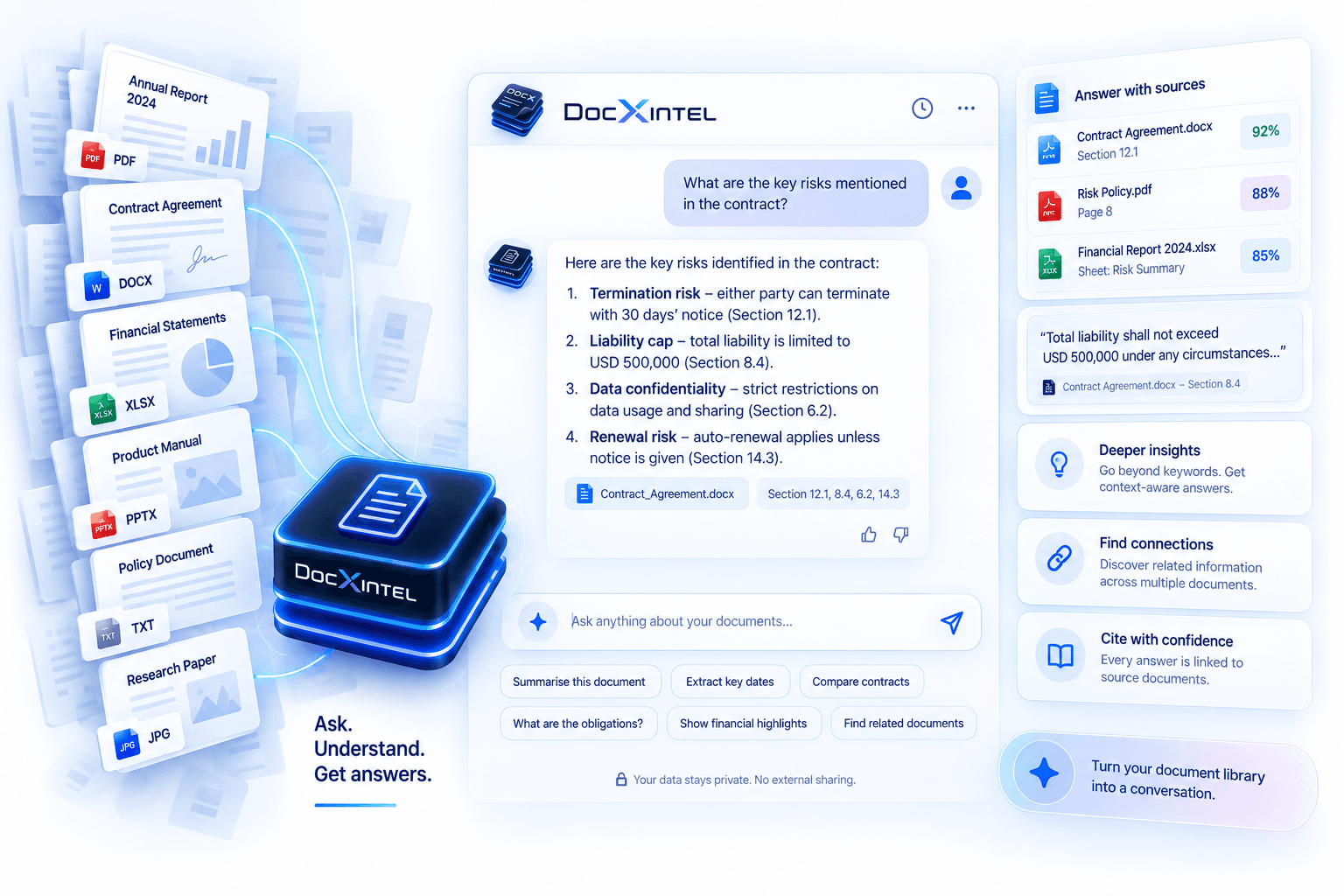
A natural-language question answered from documents with citations pointing back to specific page regions
Every claim
Cited to a page region
page and bounding box
0 bytes
Prompts leaving your network
model served locally
No training
On your documents
weights stay as shipped
Unmetered
Questions asked
fixed annual licence

Answer quality on your own corpus is measured during the Proof of Value against a human-adjudicated question set you help write, including questions the documents cannot answer, so refusal behaviour is tested rather than assumed.

Under the hood

What cited document question answering has to guarantee

A confident answer with no source is worse than no answer, because it costs a person an hour to disprove and a regulator one question to reject.

Citations to page and coordinates

Every claim in an answer resolves to a bounding box on a specific page of a specific document, so a reviewer can open the source and see the sentence the answer came from.

  • Bounding-box level, not chunk level
  • Multiple citations per answer
  • Links through to the original file

Refusal when evidence is absent

When retrieval finds nothing that supports an answer, the response says so and names what was searched. The system is tuned to prefer a refusal over a fluent guess.

  • Explicit not-found responses
  • Reports what was searched and excluded
  • No extrapolation beyond the sources

Arabic and English, in both directions

Ask in Arabic about English documents, or in English about Arabic documents. Retrieval crosses scripts, and citations point at the source region in its original script.

  • Cross-script retrieval and matching
  • Arabic-Indic numeral normalisation
  • Answers returned in the language asked

Permissions-aware retrieval

Access control is applied to the index before generation, using the identity from your own OIDC or SAML provider. The model is never shown a passage the user could not open themselves.

  • Role and attribute-based filtering
  • Document-class and field-level rules
  • Enforced in retrieval, not in the prompt

The model runs on your GPUs

Open-weight models ship in the deployment bundle and are served inside your network. There is no hosted inference endpoint and no overflow call to a cloud model under load.

  • Weights shipped, pinned and versioned by you
  • No egress, no phone-home, no fallback
  • Identical behaviour air-gapped

Grounded in structure, not just text

Retrieval draws on the analysed document — table grids, typed fields and the entity graph — so a question about a total finds the cell, not a paragraph that happens to mention totals.

  • Table-aware and field-aware retrieval
  • Entity graph used to expand a question
  • Document class used to narrow scope
Why the answers hold up

Retrieval over an understood document, not a pile of text chunks.

Most private Q&A projects fail at the same place: the corpus was flattened into text before it was understood, so the index has no idea which number was in which cell, which page a clause spanned, or that three documents describe one person. DocxIntel asks questions of the output of five other capabilities.

  • Analysis supplies reading order and table grids, so a cell reference survives into the citation
  • Identification supplies typed fields, so a question about a policy limit matches a policy-limit field
  • Classification narrows retrieval to the document classes that can actually answer the question
  • Mapping supplies the entity graph, so a question about one person reaches all forty of their documents
  • Every citation inherits the coordinates that were resolved once, at ingest, and never discarded

The quality of an answer is decided long before the question is asked.

See how entities are mapped
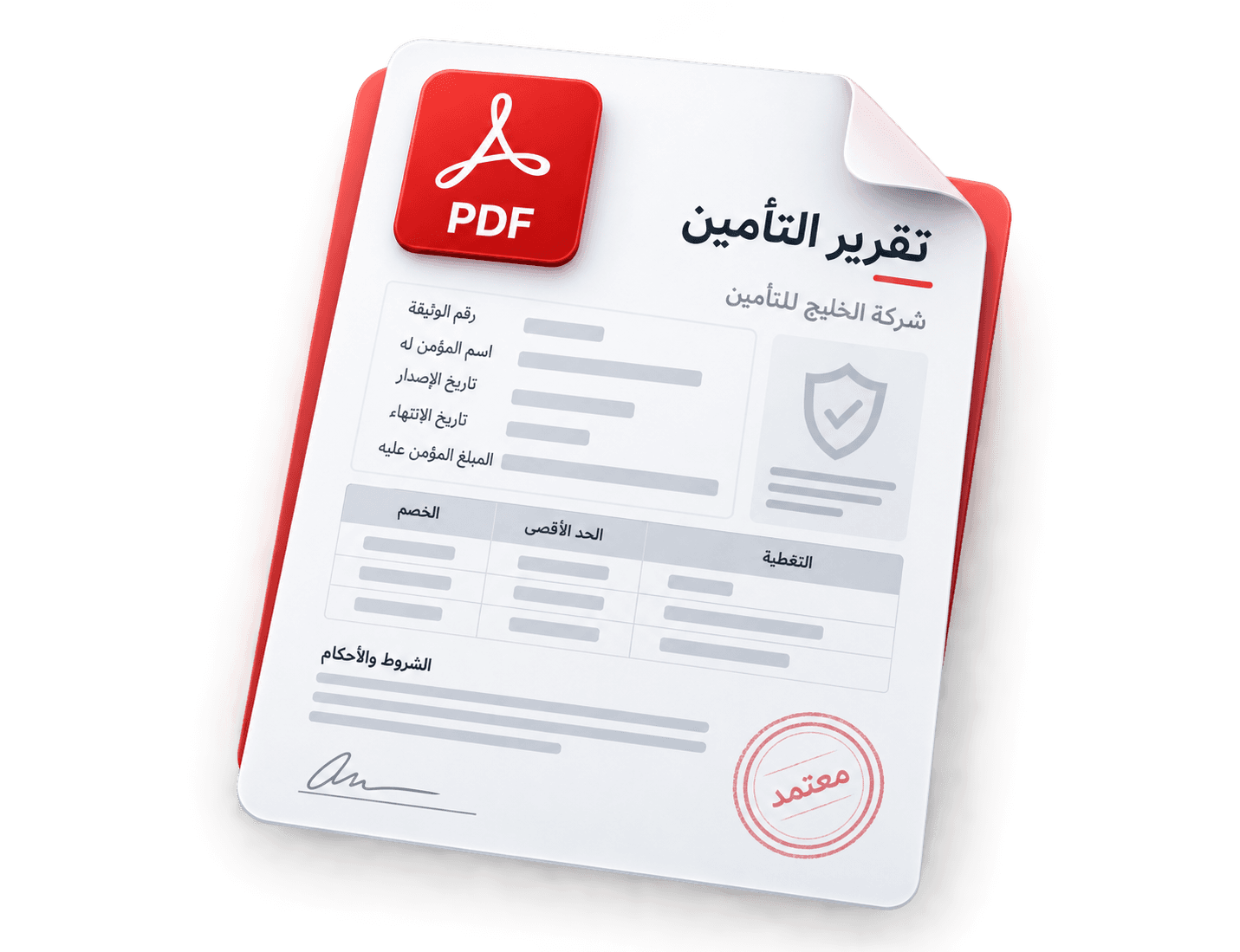
An Arabic document being retrieved and cited as the source of a natural-language answer
What happens to a question

From a typed question to a cited answer, entirely inside your perimeter

An adjuster asks: was this vehicle covered on the incident date, and does the repair estimate exceed the excess?

  1. 1
    Step 1

    The user is identified and scoped

    Your OIDC or SAML provider supplies the identity. Roles and attributes resolve into a retrieval filter before any search runs, so the searchable corpus for this question is only what this person may see.

  2. 2
    Step 2

    Retrieval runs over structure and text together

    Hybrid lexical and vector search across passages, table cells, typed fields and the entity graph, in both Arabic and English, returns candidate evidence with document, page and coordinates attached.

  3. 3
    Step 3

    Evidence is re-ranked and checked for sufficiency

    Candidates are re-ranked, and the set is tested against the question. If nothing supports an answer — the policy schedule for that date is simply not in the estate — the pipeline stops here and returns a refusal.

  4. 4
    Step 4

    The local model composes an answer from that evidence only

    The language model runs on your GPUs. It receives the retrieved passages and the question, and is constrained to answer from them. No prompt, passage or answer crosses your network boundary.

  5. 5
    Step 5

    Each claim is bound to a citation before release

    Claims that cannot be attributed to a retrieved region are dropped rather than shown. The answer arrives as text plus a citation list of documents, pages and bounding boxes.

  6. 6
    Step 6

    The exchange is logged for audit

    Question, user, retrieval filter, evidence used, answer and citations are appended to your own audit log and can be shipped to your SIEM — so an answer given in March is reviewable in November.

Positioning

Private document Q&A versus a cloud LLM or RAG API

Cloud models are excellent. The problem is the shape of the transaction: to get an answer about a customer file, the customer file has to be sent to somebody else.

Private document Q&A versus a cloud LLM or RAG API
CriterionCloud LLM or RAG APIEnterprise BYOC tierDocxIntel
Where prompts and documents goVendor inference endpointYour cloud tenant, vendor imagesYour GPUs, inside your network
Works with no internet connectionNoRequires cloud connectivityYes, by default
Granularity of citationsText chunk, sometimes a pageText chunk, sometimes a pagePage number and bounding box
Behaviour with no supporting evidenceOften answers anywayOften answers anywayExplicit refusal naming the gap
Permissions applied to retrievalYour responsibility to buildYour responsibility to buildBuilt in, enforced before generation
Retention of submitted contentPer vendor policy, often cachedsome managed parsers cache parsed data for 48 hours by defaultPer vendor policy in your tenantOnly in your own storage
Training on your contentContractually excluded, technically possibleContractually excludedNo path for it to happen
Cost of asking ten thousand questionsMetered per tokenMetered per tokenNo incremental charge
Arabic questions over Arabic documentsVaries by modelVaries by modelFirst-class in both directions

Where prompts and documents go

Cloud LLM or RAG API
Vendor inference endpoint
Enterprise BYOC tier
Your cloud tenant, vendor images
DocxIntel
Your GPUs, inside your network

Works with no internet connection

Cloud LLM or RAG API
No
Enterprise BYOC tier
Requires cloud connectivity
DocxIntel
Yes, by default

Granularity of citations

Cloud LLM or RAG API
Text chunk, sometimes a page
Enterprise BYOC tier
Text chunk, sometimes a page
DocxIntel
Page number and bounding box

Behaviour with no supporting evidence

Cloud LLM or RAG API
Often answers anyway
Enterprise BYOC tier
Often answers anyway
DocxIntel
Explicit refusal naming the gap

Permissions applied to retrieval

Cloud LLM or RAG API
Your responsibility to build
Enterprise BYOC tier
Your responsibility to build
DocxIntel
Built in, enforced before generation

Retention of submitted content

Cloud LLM or RAG API
Per vendor policy, often cachedsome managed parsers cache parsed data for 48 hours by default
Enterprise BYOC tier
Per vendor policy in your tenant
DocxIntel
Only in your own storage

Training on your content

Cloud LLM or RAG API
Contractually excluded, technically possible
Enterprise BYOC tier
Contractually excluded
DocxIntel
No path for it to happen

Cost of asking ten thousand questions

Cloud LLM or RAG API
Metered per token
Enterprise BYOC tier
Metered per token
DocxIntel
No incremental charge

Arabic questions over Arabic documents

Cloud LLM or RAG API
Varies by model
Enterprise BYOC tier
Varies by model
DocxIntel
First-class in both directions

Comparison reflects publicly documented behaviour of managed LLM, parsing and retrieval services as of 2026, including per-token and per-page metering, default caching of parsed data and self-hosting gated to enterprise plans. Verify against current vendor documentation before making a decision.

Compare the options in detail
Reference

Retrieval and serving stack

What runs where, in a standard deployment, when the Ask capability is enabled.

Retrieval

Search strategy
Hybrid lexical and dense vector retrieval with a cross-encoder re-ranking stage
Index contents
Passages, table cells, typed fields and entity-graph nodes, each with page and coordinates
Embeddings
Multilingual open-weight embedding model served locally; no external embedding call
Filters
Identity, role, attribute, document class, date range, language and entity scope
Sufficiency check
Evidence set tested against the question before generation; failure returns a refusal

Model serving

Language model
Open-weight instruction-tuned model shipped in the bundle, pinned to a version you control
Hardware
Your GPUs, on-premise or in your private cloud; sizing depends on concurrency targets
Network behaviour
No outbound calls, no telemetry containing document text, no overflow to a hosted model
Updates
Signed offline bundles imported on your schedule; the running weights do not change silently
Training and fine-tuning
None on your content; nothing is transmitted anywhere to be learned from

Interfaces and governance

Access
REST and streaming endpoints on your own hostnames, plus a built-in review interface
Answer payload
Answer text, citation list with document, page and bounding box, and a confidence signal
Audit log
Question, user, filter, evidence, answer and citations, append-only, into your SIEM
Scaling
Independent retrieval and generation worker pools — see sizing and throughput

Model selection, GPU sizing and concurrency targets for a specific deployment are agreed in writing during the Proof of Value, against your own corpus and your own question set.

Questions risk teams ask about document Q&A

What gets asked when the phrase generative AI appears in a paper going to a board committee.

Two things. Answers are generated only from retrieved passages, and every claim in the answer must be attributable to a specific region of a specific page or it is not emitted. When the retrieved evidence does not support an answer, the response is an explicit refusal naming what was searched and what was missing, rather than a plausible sentence. A refusal is a correct answer, and the system is tuned to prefer it over a guess.

On your GPUs, inside your network. The model ships as open weights in the deployment bundle and is served locally, so the prompt, the retrieved document passages and the generated answer never cross your perimeter. There is no fallback call to a hosted model when load is high, which is the behaviour that usually breaks an air-gapped guarantee.

Yes, and it can answer an Arabic question from English documents or an English question from Arabic documents. Retrieval operates across scripts, so a question about a policyholder written in Arabic will find the Latin-script policy schedule that mentions the same person. Citations point at the source region in its original script.

No. Retrieval is permissions-aware and filters at the index level before generation, using the identity from your own OIDC or SAML provider. A user asking a broad question receives an answer built only from documents their role and attributes permit, and the citation list contains nothing they could not open directly. This is enforced in retrieval, not by asking the model to be discreet.

Never. There is no training, no fine-tuning on your content and no telemetry containing document text, because there is nowhere for that data to go. Model updates arrive as signed offline bundles you import on your own schedule, and the weights you run are the weights we shipped.

It is not priced per token or per page. Question answering is part of the fixed annual licence, sized by deployment footprint, so an analyst asking four hundred questions in a day costs the same as one asking four. That changes behaviour: people explore the estate instead of rationing queries against a budget.

Keep reading

All capabilities→How analyse, identify, classify, map, modify and ask compose into one platform.Map→The entity graph that lets one question reach every document about one person.Analyse→The structure and coordinates that make a citation point at a region, not a chunk.Identify→The typed fields that let a question about a policy limit match a policy-limit value.Security→Permissions, audit logging, key custody and what never leaves your network.Sizing and throughput→GPU requirements for serving retrieval and generation at your concurrency.

Start with a paid Proof of Value.

Thirty to forty-five days, fixed fee, deployed in your environment. The accuracy threshold and the conversion price are both agreed in writing before we begin.

Talk to an engineer
How the Proof of Value works
  • No per-page metering
  • Runs in your environment
  • Written accuracy threshold
DocxIntel Logo

A product of BizfyLabs

Document intelligence that never leaves your building. Analyse, identify, classify, map, modify and ask — inside your own infrastructure.

BizfyLabs on LinkedInDocxIntel documentationBizfyLabs

Product

  • Capabilities
    • Analyse
    • Identify
    • Classify
    • Map
    • Modify
    • Ask
  • Accuracy benchmark
  • Pricing
  • Proof of Value

Technical

  • Deployment models
  • Reference architectures
  • Sizing & throughput
  • What's in the box
  • Security posture
  • Model licences
  • Documentation
  • API reference

Solutions

  • All industries
  • Insurance & TPAs
  • Healthcare
  • Banking & finance
  • Government
  • Legal
  • Energy & logistics

Compare

  • Compare approaches
  • LlamaParse alternative
  • Docsumo alternative
  • On-premise document AI

Company

  • About DocxIntel
  • FAQ
  • Partners
  • BizfyLabs
  • Careers
  • Contact

© 2026 BizfyLabs FZC LLC. All rights reserved.

DocxIntel™ is a product of BizfyLabs FZC LLC.

  • Privacy Policy·
  • Terms of Service·
  • Data Processing Addendum·
  • Acceptable Use·
  • Model Licences·
  • Security·
  • Cookies

Registered in the United Arab Emirates. Delivery partner: Bizfy Solutions LLP, Indore, India.

DocxIntel