DocxIntel home
DocxIntel, a product of BizfyLabs
by
BizfyLabs
  • Capabilities
    • Analyse

      Resolve layout, reading order, tables and handwriting

    • Identify

      Pull entities, fields and clauses with coordinates

    • Classify

      Sort document types and split multi-page packets

    • Map

      Link and reconcile entities across your estate

    • Modify

      Redact, mask and transform documents safely

    • Ask

      Query your documents and get cited answers

    • All six capabilities, one platform→
  • Deployment
  • Accuracy
  • Industries
    • Banking & Financial Services

      Statements, KYC files, and financial filings

    • Insurance

      Claims, policies, and underwriting documents

    • Government & Public Sector

      Records, correspondence, and regulatory filings

    • Healthcare

      Patient records, referrals, and lab reports

    • Legal & Compliance

      Contracts, filings, and case documentation

    • Energy & Utilities

      Engineering documents, contracts, and reports

    • Every regulated industry we serve→
  • Pricing
  • Docs
Book a Demo
Home
DocXIntel

Menu

    • All capabilities
    • Analyse
    • Identify
    • Classify
    • Map
    • Modify
    • Ask
    • All industries
    • Banking & Financial Services
    • Insurance
    • Government & Public Sector
    • Healthcare
    • Legal & Compliance
    • Energy & Utilities
    • Deployment models
    • Reference architectures
    • Sizing & throughput
    • What's in the box
    • Security posture
    • Documentation
    • Accuracy benchmark
    • Pricing
    • Proof of Value
    • Compare
    • About
    • FAQ
    • Contact Us
Solutions by industry

Document intelligence for the industries where documents cannot leave the building.

Insurers, hospitals, banks, ministries, law firms and energy operators all process documents they are not permitted to send anywhere. DocxIntel installs inside your own infrastructure with the models in the bundle, so the hardest documents in your sector are read on your hardware and nowhere else.

  • Six regulated sectors
  • Runs air-gapped
  • Arabic-native
  • No per-page charge
Talk to an engineer about your sector
See the deployment models
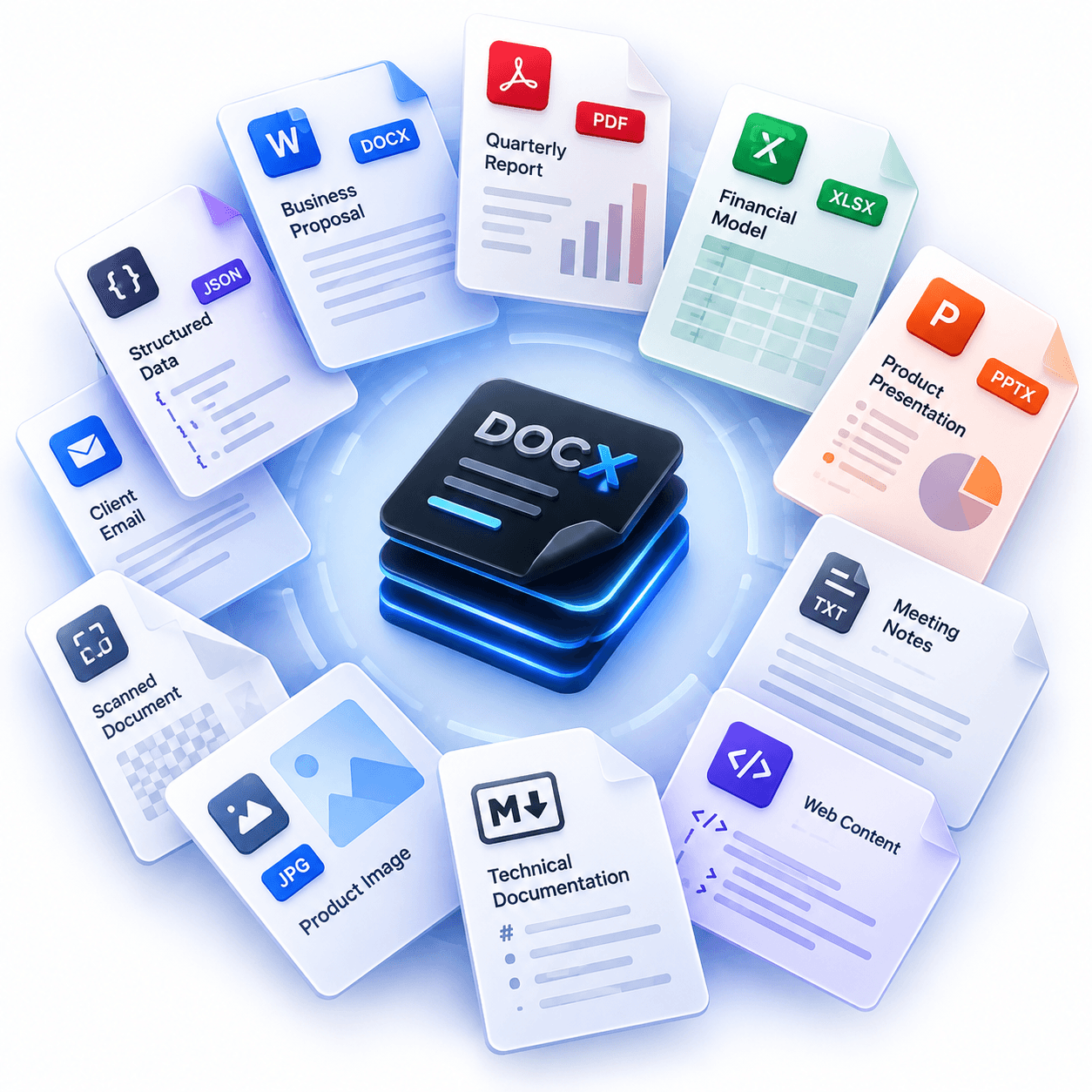
DocxIntel processing documents from insurance, healthcare, banking, government, legal and energy workflows on-premise
6
Industries covered
one platform, one licence
99%
Field-level accuracy
on the published benchmark set
0 bytes
Leaving your network
air-gapped installs
Fixed annual
Licence model
sized by footprint, never per page

Accuracy is measured field-by-field against a human-adjudicated ground truth, not character-by-character. The document mix and per-field breakdown are published in full on the accuracy page, and your own threshold is agreed in writing during the Proof of Value.

Choose your sector

Six industries, the same on-premise guarantee

The platform does not change between sectors. The document mix, the field schema and the downstream systems do — so each page below is written around what that industry actually receives every day.

Insurance

Claims, policies and reimbursement

Motor and medical claim packets arrive as one long scan of everything the claimant had. DocxIntel splits the packet, reconciles the claim against the policy schedule and flags duplicate or altered invoices.

  • Auto-split of mixed claim packets
  • Claim-versus-policy reconciliation
  • Duplicate invoice detection
Insurance document processing →
Healthcare

Prescriptions, labs and pre-approvals

Handwritten prescriptions, lab reports and discharge summaries are read inside the hospital network. Protected health information never reaches an external API, which is what the data-localisation rule requires.

  • Handwritten prescription digitisation
  • Insurance pre-authorisation packs
  • Coding source documents
Healthcare document processing →
Banking

KYC, trade finance and credit files

Emirates ID, passports, trade licences, letters of credit and salary certificates are extracted, checked for completeness and examined for discrepancies without a page leaving the bank.

  • KYC and onboarding packs
  • Trade finance document examination
  • Credit file assembly
Banking document processing →
Government

Citizen services and archives

Handwritten Arabic application forms, permits, court files and decades of scanned archive run on sovereign infrastructure — including networks with no route to the internet at all.

  • Service-request digitisation
  • Archive backfile conversion
  • Records classification and retention
Government document processing →
Legal

Contracts, disclosure and diligence

Clause extraction, obligation tracking and privilege-aware redaction across contracts, filings and data rooms — with no third-party API in the chain of custody.

  • Clause and obligation extraction
  • Due-diligence review at volume
  • Privilege-aware redaction
Legal document processing →
Energy and logistics

Field documents and three-way matching

Bills of lading, delivery notes photographed on a phone at a gate, inspection reports and contractor invoices — reconciled from images that other tools reject outright.

  • Three-way invoice matching
  • Proof-of-delivery from phone photos
  • Inspection report digitisation
Energy and logistics document processing →
The shared constraint

Every one of these industries has the same problem, and it is not accuracy.

Ask a bank CISO, a hospital CIO and a ministry records director what blocks document automation and you get one answer in three accents: the documents are not allowed to leave. Accuracy is negotiable; custody is not.

  • A metered cloud service must receive the page before it can read it — that is the whole architecture
  • Data-residency wording in a contract is not the same control as a network with no outbound route
  • A vendor BYOC tier still runs vendor-controlled images in a cloud tenant, on the top plan only
  • DocxIntel ships open-weight models into your environment, so you hold the weights and the keys
  • Nothing phones home: no telemetry beacon, no licence check-in, no fallback call when confidence is low

This is why on-premise is the default here rather than an enterprise upgrade path. The deployment model is the product decision.

Read how air-gapped deployment works
Air-gapped DocxIntel deployment architecture showing documents and models contained inside the customer network
Why regulated industries specifically

The rules that push document processing inside the perimeter

These are the frameworks that come up in every evaluation across the six sectors. DocxIntel is infrastructure you operate, so your compliance position stays yours to certify — the architecture is designed to make that certification straightforward rather than to claim it on your behalf.

CBUAE outsourcing and data residency

Central Bank expectations on outsourcing and where regulated data sits make a foreign processing endpoint an approval problem. A deployment inside your own data centre removes the outsourcing question rather than answering it.

  • No third-party processor in the path
  • Applies to banking and bancassurance
  • Your own change control

UAE PDPL

Personal data in claim forms, KYC packs and citizen applications carries lawful-basis, minimisation and cross-border transfer obligations. Processing that never crosses a border does not need a transfer mechanism.

  • No cross-border transfer to assess
  • Retention governed by your storage policy
  • DocxIntel holds no copy

UAE Health ICT Law

Health data generated in the UAE is subject to a data-localisation requirement. Reading a prescription inside the hospital network is the only version of prescription automation that satisfies it cleanly.

  • PHI stays on hospital infrastructure
  • No external inference call
  • Strongest single on-premise case

AML and CFT record keeping

Financial-crime rules require records to be retrievable and evidenced for years. Field-level traceability means an extracted value can be shown back to the pixels it came from, on the page it came from.

  • Page and bounding-box provenance
  • Per-field confidence scores
  • Stable identifiers across re-runs

Sovereignty and classified handling

Public-sector and defence-adjacent networks are frequently isolated by policy, not preference. An install that works identically with no route to the internet is a prerequisite, not a feature request.

  • Offline install and offline updates
  • No phone-home or licence beacon
  • Runs on bare metal

GDPR for cross-border groups

Groups with European entities or European counterparties inherit GDPR obligations on top of local rules. Keeping processing in one controlled environment collapses several of those obligations into one.

  • Single processing location
  • Documented data flows
  • Deletion under your control
Reference

What each sector brings, and what rules out the cloud

A side-by-side of the document mix and the binding constraint per industry, as they come up in real evaluations.

The documents that arrive

Insurance
Motor and medical claim packets, policy schedules, FNOL forms, police reports, garage estimates, medical reports, reimbursement forms
Healthcare
Handwritten prescriptions, lab reports, discharge summaries, pre-approval forms, referral letters, consent forms, coding source documents
Banking
KYC packs, account opening forms, letters of credit, bills of lading, salary certificates, bank statements, board resolutions
Government
Handwritten Arabic application forms, permits and licences, scanned historical archives, court files, tender documents, correspondence
Legal
Contracts and amendments, NDAs, court filings and judgments, due-diligence data rooms, regulatory correspondence, board minutes
Energy and logistics
Bills of lading, delivery notes and proof-of-delivery photos, inspection and maintenance reports, meter readings, HSE incident reports, contractor invoices

The constraint that decides the architecture

Insurance
Claim packets contain health data and identity documents together, under PDPL and health-data handling rules at the same time
Healthcare
Data localisation under the UAE Health ICT Law — protected health information cannot be sent to an external inference endpoint
Banking
CBUAE outsourcing and data-residency expectations, plus AML and CFT record-keeping that has to survive an examination
Government
Sovereignty and classification — some networks have no outbound route by policy, and Arabic handwriting dominates the intake
Legal
Privilege and confidentiality undertakings that a third-party processing API is difficult to reconcile with
Energy and logistics
Offshore and remote sites with unreliable connectivity, and field-captured images too poor for template-based tools

Regulatory references are provided as context for evaluation, not as legal advice. Confirm the current obligations that apply to your entity with your own compliance function.

Positioning

Regulated document processing: on-premise against metered cloud IDP

Cloud IDP platforms are capable products. The difference is structural rather than qualitative — per-page metering requires every page to reach the vendor, and self-hosting sits on the top tier.

Regulated document processing: on-premise against metered cloud IDP
CriterionMetered cloud IDPVendor BYOC tierDocxIntel
Where documents are readVendor cloudYour cloud tenantYour infrastructure, including bare metal
True air-gapped operationNot availableRequires connectivitySupported by default
Residency evidence for a regulatorContractual commitmentYour cloud regionYour own network diagram
Cost of 1M pages a monthRoughly $150k to $3.6M a yearillustrative list-rate arithmetic at $0.0125 to $0.30 per pageStill metered per pageFixed annual licencesized by deployment footprint
Reprocessing the archive after a model updateCharged again per pageCharged again per pageNo incremental charge
Model weightsVendor-hostedVendor-controlled imagesShipped to you in the bundle
Self-hosting available onNo planTop enterprise tier onlyEvery licence
Arabic as a primary scriptBest-effortBest-effortFirst-class

Where documents are read

Metered cloud IDP
Vendor cloud
Vendor BYOC tier
Your cloud tenant
DocxIntel
Your infrastructure, including bare metal

True air-gapped operation

Metered cloud IDP
Not available
Vendor BYOC tier
Requires connectivity
DocxIntel
Supported by default

Residency evidence for a regulator

Metered cloud IDP
Contractual commitment
Vendor BYOC tier
Your cloud region
DocxIntel
Your own network diagram

Cost of 1M pages a month

Metered cloud IDP
Roughly $150k to $3.6M a yearillustrative list-rate arithmetic at $0.0125 to $0.30 per page
Vendor BYOC tier
Still metered per page
DocxIntel
Fixed annual licencesized by deployment footprint

Reprocessing the archive after a model update

Metered cloud IDP
Charged again per page
Vendor BYOC tier
Charged again per page
DocxIntel
No incremental charge

Model weights

Metered cloud IDP
Vendor-hosted
Vendor BYOC tier
Vendor-controlled images
DocxIntel
Shipped to you in the bundle

Self-hosting available on

Metered cloud IDP
No plan
Vendor BYOC tier
Top enterprise tier only
DocxIntel
Every licence

Arabic as a primary script

Metered cloud IDP
Best-effort
Vendor BYOC tier
Best-effort
DocxIntel
First-class

Cost figures are our own arithmetic on publicly published list rates as of 2026 — roughly $0.0125 per page for agentic cloud parsing and around $0.30 per page on a usage-based IDP growth plan — not vendor quotations. Self-hosting availability reflects publicly documented plan gating. Verify against current vendor documentation before making a decision.

See the full comparison
How a sector engagement runs

From your document sample to production, in your environment

The path is the same in every industry. What differs is the field schema and which of your systems receives the output.

  1. 1
    Week 0

    We look at your worst documents, not your best

    A representative sample matters more than a large one: the photographed delivery note, the handwritten Arabic form, the stamped invoice, the fourth-generation fax. If the difficult 5% is missing from the sample, the accuracy number is not meaningful.

  2. 2
    Week 1

    Threshold and price are agreed in writing

    The Proof of Value fixes the fee, the field-level accuracy threshold, the document set it will be measured on and the conversion price if it passes. Nothing about the commercial outcome is left to a later conversation.

  3. 3
    Weeks 1-2

    The bundle is installed inside your perimeter

    Containers and open-weight models are installed on your hardware — air-gapped, private cloud or managed single-tenant. Your infrastructure team keeps root, the keys and the change window.

  4. 4
    Weeks 2-4

    The field schema is configured against your forms

    Document types, fields, validation rules and routing are configured on your actual documents. No template library is required, and no sample leaves the environment it was loaded into.

  5. 5
    Weeks 4-6

    Accuracy is measured against the agreed threshold

    Results are adjudicated field-by-field with your reviewers, and the report shows per-field accuracy, confidence distribution and the exceptions that need a human. Miss the threshold and you keep the report and owe nothing further.

  6. 6
    After the pilot

    Production rollout on a fixed annual licence

    Volume grows without the bill growing. Adding a new document type or reprocessing the back catalogue is a configuration change and some GPU time, not a new line item.

Questions regulated buyers ask first

The objections that decide whether document automation gets approved at all, answered without hedging.

No. It is one platform with one deployment bundle and one licence. What changes per industry is the document mix, the field schema and the systems output is written back into. Insurance claim packets, hospital prescriptions and trade finance files all move through the same six capabilities — Analyse, Identify, Classify, Map, Modify and Ask.

Because the constraint is not cost, it is custody. A metered cloud service has to receive the page before it can read it, which means the document leaves the perimeter it is legally obliged to stay inside. DocxIntel inverts that: the models come to your data centre instead of your documents going to a vendor.

DocxIntel is template-free by design, so it does not depend on a pre-built layout for your forms. During the Proof of Value we configure the field schema against your actual documents — your claim forms, your KYC packs, your inspection reports — and measure accuracy on that set rather than on a generic sample.

The architecture is designed against CBUAE outsourcing and data-residency expectations, UAE PDPL, the UAE Health ICT Law data-localisation requirement and GDPR. DocxIntel is infrastructure you control, so the compliance position is yours to certify — we supply the deployment evidence, audit logs and data-flow documentation your assessors ask for.

It is the case DocxIntel was built for. Arabic is a first-class script: right-to-left reading order, Arabic-Indic numerals, mixed Arabic and English on the same page, handwriting and stamps over printed text. Government service forms and insurance claim packets in the GCC are the hardest version of this problem and the reason the platform exists.

Through a paid Proof of Value: 30 to 45 days, fixed fee, deployed in your own environment on your own documents. The accuracy threshold and the conversion price are agreed in writing before any work starts. If the threshold is missed, you keep the report and owe nothing further.

Keep reading

Deployment models→Air-gapped, private cloud, managed single-tenant or evaluation sandbox — and how to choose.Security architecture→Isolation, audit logging, key handling and the controls your assessors will ask about.Accuracy benchmark→The document mix, the methodology and the per-field numbers behind the 99% claim.Proof of Value→Thirty to forty-five days, fixed fee, your documents, your environment, written threshold.Pricing→Why a fixed annual licence beats per-page metering once volume is real.Capabilities→Analyse, Identify, Classify, Map, Modify and Ask — the six layers every sector uses.

Start with the documents your current tool sends to manual review.

Thirty to forty-five days, fixed fee, deployed in your environment on your sector's real documents. The accuracy threshold and the conversion price are both agreed in writing before we begin.

Talk to an engineer
How the Proof of Value works
  • No per-page metering
  • Runs in your environment
  • Written accuracy threshold
DocxIntel Logo

A product of BizfyLabs

Document intelligence that never leaves your building. Analyse, identify, classify, map, modify and ask — inside your own infrastructure.

BizfyLabs on LinkedInDocxIntel documentationBizfyLabs

Product

  • Capabilities
    • Analyse
    • Identify
    • Classify
    • Map
    • Modify
    • Ask
  • Accuracy benchmark
  • Pricing
  • Proof of Value

Technical

  • Deployment models
  • Reference architectures
  • Sizing & throughput
  • What's in the box
  • Security posture
  • Model licences
  • Documentation
  • API reference

Solutions

  • All industries
  • Insurance & TPAs
  • Healthcare
  • Banking & finance
  • Government
  • Legal
  • Energy & logistics

Compare

  • Compare approaches
  • LlamaParse alternative
  • Docsumo alternative
  • On-premise document AI

Company

  • About DocxIntel
  • FAQ
  • Partners
  • BizfyLabs
  • Careers
  • Contact

© 2026 BizfyLabs FZC LLC. All rights reserved.

DocxIntel™ is a product of BizfyLabs FZC LLC.

  • Privacy Policy·
  • Terms of Service·
  • Data Processing Addendum·
  • Acceptable Use·
  • Model Licences·
  • Security·
  • Cookies

Registered in the United Arab Emirates. Delivery partner: Bizfy Solutions LLP, Indore, India.

DocxIntel