DocxIntel home
DocxIntel, a product of BizfyLabs
by
BizfyLabs
  • Capabilities
    • Analyse

      Resolve layout, reading order, tables and handwriting

    • Identify

      Pull entities, fields and clauses with coordinates

    • Classify

      Sort document types and split multi-page packets

    • Map

      Link and reconcile entities across your estate

    • Modify

      Redact, mask and transform documents safely

    • Ask

      Query your documents and get cited answers

    • All six capabilities, one platform→
  • Deployment
  • Accuracy
  • Industries
    • Banking & Financial Services

      Statements, KYC files, and financial filings

    • Insurance

      Claims, policies, and underwriting documents

    • Government & Public Sector

      Records, correspondence, and regulatory filings

    • Healthcare

      Patient records, referrals, and lab reports

    • Legal & Compliance

      Contracts, filings, and case documentation

    • Energy & Utilities

      Engineering documents, contracts, and reports

    • Every regulated industry we serve→
  • Pricing
  • Docs
Book a Demo
Home
DocXIntel

Menu

    • All capabilities
    • Analyse
    • Identify
    • Classify
    • Map
    • Modify
    • Ask
    • All industries
    • Banking & Financial Services
    • Insurance
    • Government & Public Sector
    • Healthcare
    • Legal & Compliance
    • Energy & Utilities
    • Deployment models
    • Reference architectures
    • Sizing & throughput
    • What's in the box
    • Security posture
    • Documentation
    • Accuracy benchmark
    • Pricing
    • Proof of Value
    • Compare
    • About
    • FAQ
    • Contact Us
Industry — Legal

Legal document processing that keeps privileged material inside the firm.

Law firms and in-house legal teams hold documents they are professionally obliged not to disclose. DocxIntel extracts clauses, tracks obligations, reviews diligence at volume and redacts for disclosure — with the models running inside your own firewall and no third-party API in the chain of custody.

  • No third-party API
  • Clause-level citations
  • True content redaction
  • No per-page charge
Book a review walkthrough
Review the security architecture
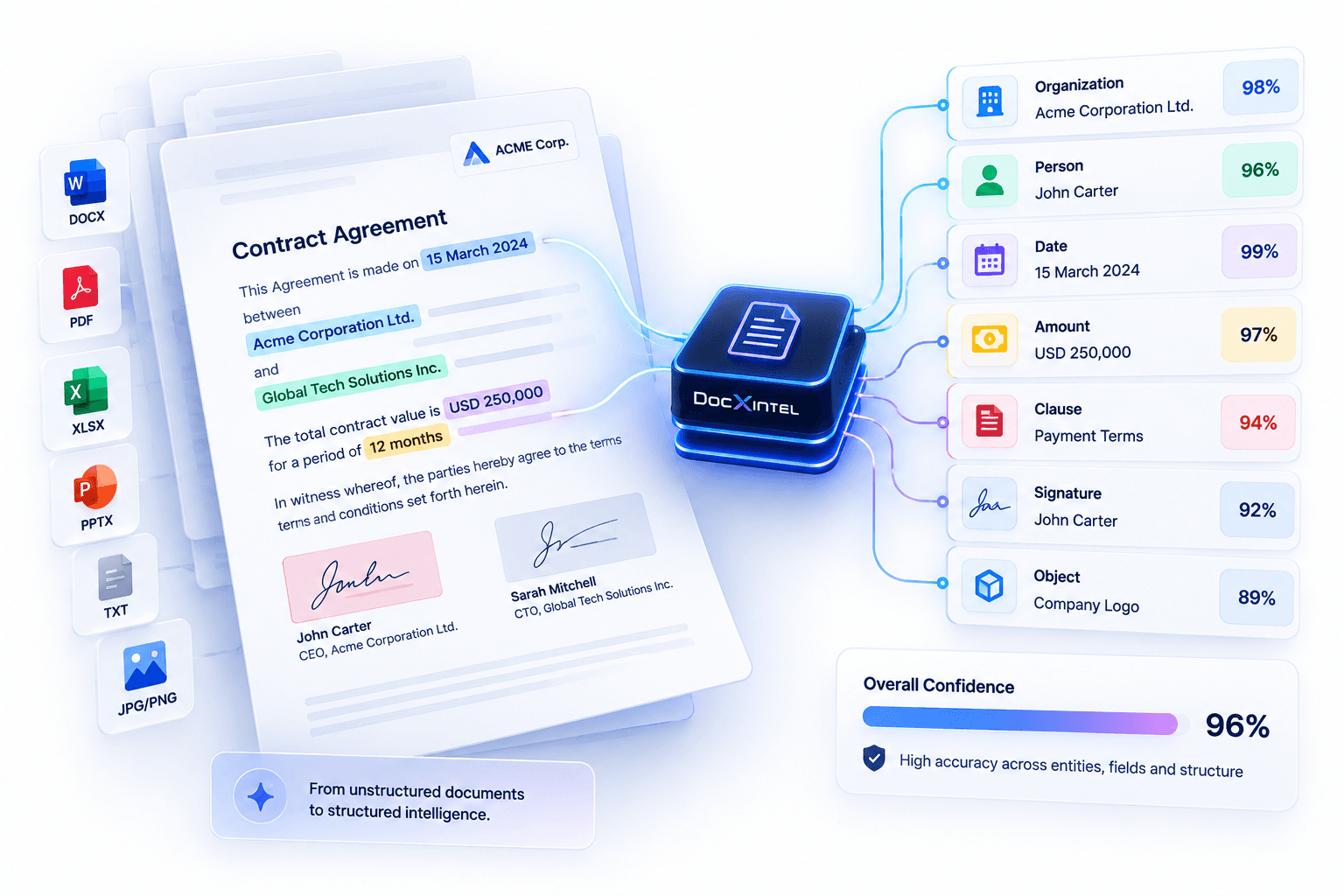
Contract clauses identified on a page with obligations extracted and traced back to their source coordinates
0
External recipients
nothing leaves the firewall
99%
Field-level accuracy
on the published benchmark set
Cited
Every clause and obligation
page and bounding box
Unmetered
Diligence pages reviewed
fixed annual licence

Accuracy is measured field-by-field against a human-adjudicated ground truth, not character-by-character. Extraction output is input to legal judgement, never a substitute for it — the reviewing lawyer remains responsible for the advice given.

What it processes

The legal documents and workflows that consume fee-earner hours

Legal review does not slow down because lawyers read slowly. It slows down because someone has to find the relevant paragraph across four thousand documents before the reading can start.

Clause extraction and obligation tracking

Clauses are identified by type and the obligations inside them extracted with dates, notice periods, thresholds and the responsible party — cited to the page they came from.

  • Termination, indemnity, liability, assignment
  • Notice periods and renewal dates
  • Obligation owner and trigger

Contract review and deviation detection

An incoming draft is compared against your own playbook positions, and every difference is reported as a specific, cited deviation for a lawyer to judge.

  • Playbook position comparison
  • Cited deviation reports
  • Amendment and side-letter tracking

Due-diligence review at volume

Data rooms are classified, deduplicated and indexed so a diligence team starts from a structured contract inventory rather than a folder tree.

  • Data-room classification
  • Duplicate and near-duplicate grouping
  • Change-of-control screening

Privilege-aware redaction

Privileged and confidential material is redacted at the content level across a disclosure set, with every redaction logged and justifiable on review.

  • Content removed, not covered
  • Consistent categories across a set
  • Full redaction audit log

Court filings and judgments

Filings, pleadings, orders and judgments are indexed by party, case reference and date, and made searchable with citations back to the paragraph.

  • Party and case-reference indexing
  • Order and outcome extraction
  • Chronology assembly

Board minutes and regulatory correspondence

Minutes, resolutions and regulatory correspondence are read for decisions, authorities, commitments and deadlines that in-house teams are expected to track.

  • Decisions and authorities
  • Regulatory deadlines
  • Commitment registers
End to end

A data room reviewed at volume, without a document leaving the firm.

Diligence is a triage problem before it is a legal one. The steps below run entirely inside your own environment, on documents that were never transmitted to a processing service.

  • The data room is loaded from your own storage — thousands of PDFs, scanned executed copies, amendments and unlabelled folders
  • Documents are classified by type and grouped, and duplicates and near-duplicates are collapsed so nobody reviews the same agreement twice
  • Parties, dates, governing law, term and value are extracted into a contract inventory with citations to the page
  • Clauses that matter to the transaction are pulled out by type — change of control, assignment, exclusivity, termination for convenience
  • Deviations from the expected position are listed per contract, each one cited so a fee earner reads the wording, not a summary
  • Privileged and commercially sensitive material is redacted at content level for onward disclosure, with the redactions logged

Everything produced is advisory input to legal judgement. The reviewing lawyer remains responsible for the conclusion and the advice.

See how redaction works
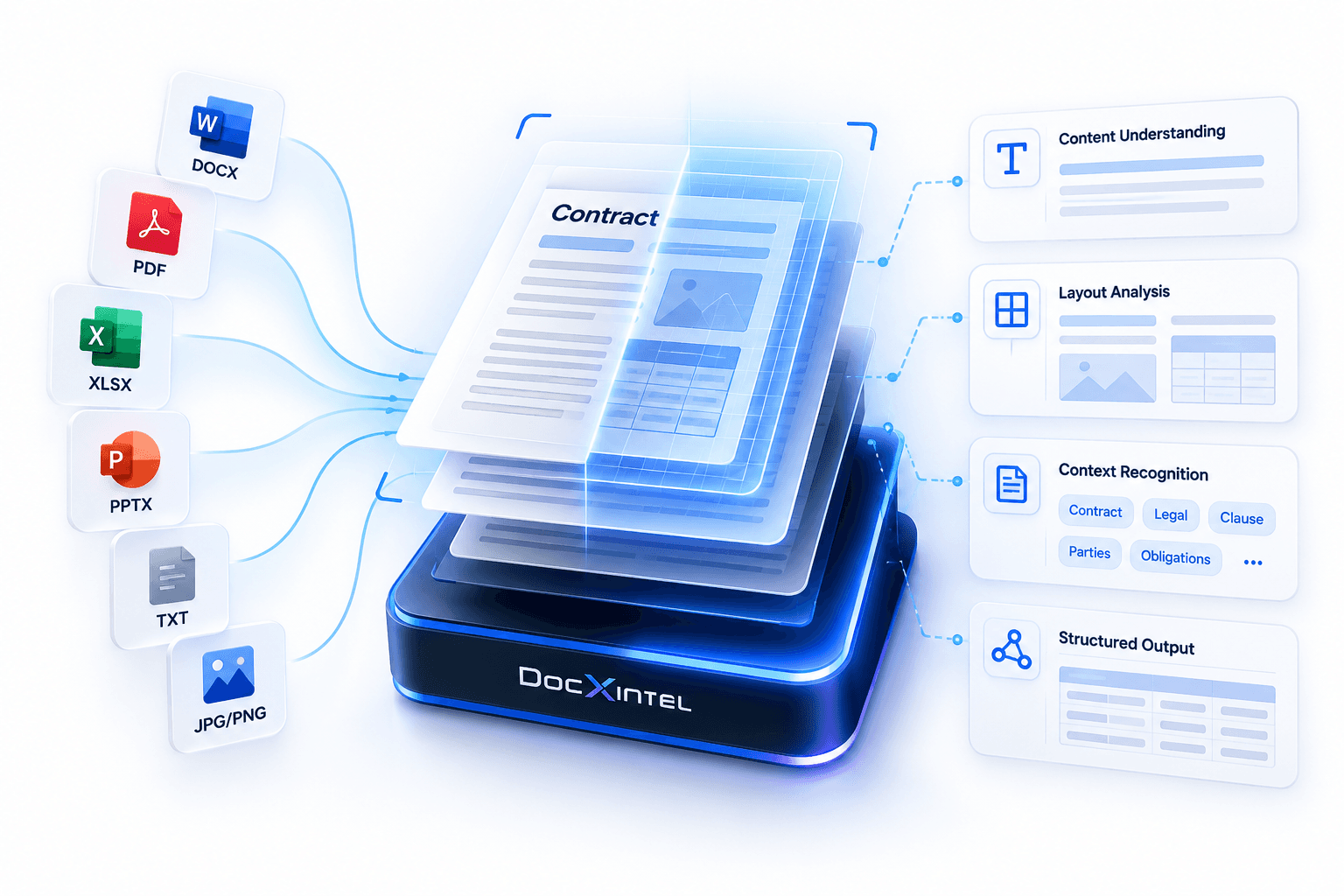
A disclosure document with privileged content redacted at content level and the redaction logged
Rollout

How a legal deployment actually starts

One matter type, inside your own environment, with the professional-obligations review done before installation rather than after.

  1. 1
    Step 1

    Choose one matter type or one contract portfolio

    A single recurring workflow — supplier contract review, a live diligence exercise, or an obligations audit across an existing portfolio — is a better first scope than the whole practice. We ask for the documents your team finds worst: scanned executed copies, bilingual agreements, amendment chains.

  2. 2
    Step 2

    Clear professional obligations and client undertakings

    Because processing stays inside the firm and nothing is transmitted onward, the review concerns internal access control, matter segregation and audit logging rather than third-party disclosure. Deployment evidence and data-flow documentation are provided for your risk function up front.

  3. 3
    Step 3

    Install inside your own environment

    Containers and open-weight models are deployed on your hardware or in your private cloud, in the segment your policy requires. Your team holds root and the encryption keys, and no client document is ever visible to us.

  4. 4
    Step 4

    Configure clause taxonomy, playbook and redaction categories

    Your clause taxonomy, standard positions, obligation fields and privilege and confidentiality categories are configured directly, then tuned against matters where the outcome is already known to your team.

  5. 5
    Step 5

    Measure with your own fee earners adjudicating

    Accuracy is adjudicated clause-by-clause and field-by-field by your own lawyers, and the report shows per-field accuracy, confidence distribution and the review load you would actually staff. Miss the agreed threshold and you keep the report and owe nothing further.

  6. 6
    Step 6

    Extend across matters and back over the archive

    Adding a practice area, or running an obligations audit across every contract the firm has ever executed, is a configuration change and some GPU time. The licence does not move because the page count did.

Reference

Legal document types and the fields extracted from each

An indicative schema. The final clause taxonomy and field list are agreed against your own precedents and playbook during the Proof of Value.

Contracts and transactional documents

Commercial contract
Parties and entity numbers, execution and effective dates, term and renewal, value and payment terms, governing law, jurisdiction, notice addresses, signature blocks
Clause-level extraction
Termination, indemnity, limitation of liability, assignment, change of control, exclusivity, confidentiality, force majeure, dispute resolution — each with its full wording and page citation
Amendments and side letters
Parent agreement reference, amendment number and date, clauses amended, superseded wording, effective date, consolidated position
NDA
Parties, mutual or one-way, definition of confidential information, permitted purpose, term and survival period, carve-outs, return or destruction obligations

Litigation and regulatory documents

Court filing and pleading
Case number, court, parties and representatives, filing date, relief sought, causes of action, hearing dates, exhibits referenced
Judgment or order
Case reference, judgment date, presiding judge, orders made, sums awarded, costs, appeal window, reasoning paragraphs cited to page
Regulatory correspondence
Regulator and reference, date received, subject, information requested, response deadline, commitments given, escalation history
Board minutes and resolutions
Meeting date, attendees and quorum, decisions taken, authorities delegated, limits granted, action owners, follow-up deadlines

Handling, redaction and provenance

Accepted inputs
Native and scanned PDF, DOCX with tracked changes, JPEG, PNG, multi-page TIFF, EML and MSG with attachments, ZIP data-room exports
Redaction behaviour
Content removed from the document rather than masked over it, applied consistently across a set, with every redaction and its basis written to your audit log
Attached to every field and clause
Page number, bounding-box coordinates, confidence score and a stable element identifier that survives re-runs
Retention
Governed entirely by your own matter-retention policy; DocxIntel holds no copy of any client document

Nothing on this page is legal advice, and extraction output is not a legal opinion. DocxIntel produces cited source material for a qualified reviewer to act on.

Positioning

Legal document review: on-premise against metered cloud IDP

Hosted review and parsing services are capable and widely used. In legal the distinguishing question is narrower: who becomes a recipient of the document, and what does that do to privilege.

Legal document review: on-premise against metered cloud IDP
CriterionMetered cloud IDPVendor BYOC tierDocxIntel
Where privileged documents are readVendor cloudYour cloud tenantYour infrastructure, including bare metal
Adds a recipient outside the firmYesVendor-controlled imagesNo
Parsed content cached by the vendorCommonly cached by defaultdocumented at 48 hours on some servicesVendor-managedNothing to cache
Named in client confidentiality undertakingsUsually requiredUsually requiredNot applicable
Cost of a 200,000-page data roomRoughly $2,500 to $60,000 per matterillustrative list-rate arithmetic at $0.0125 to $0.30 per pageStill metered per pageNo incremental chargeGPU time only
Re-running the portfolio for an obligations auditCharged again per pageCharged again per pageNo incremental charge
Redaction removes underlying contentVaries by productVaries by productContent removed
Self-hosting available onNo planTop enterprise tier onlyEvery licence

Where privileged documents are read

Metered cloud IDP
Vendor cloud
Vendor BYOC tier
Your cloud tenant
DocxIntel
Your infrastructure, including bare metal

Adds a recipient outside the firm

Metered cloud IDP
Yes
Vendor BYOC tier
Vendor-controlled images
DocxIntel
No

Parsed content cached by the vendor

Metered cloud IDP
Commonly cached by defaultdocumented at 48 hours on some services
Vendor BYOC tier
Vendor-managed
DocxIntel
Nothing to cache

Named in client confidentiality undertakings

Metered cloud IDP
Usually required
Vendor BYOC tier
Usually required
DocxIntel
Not applicable

Cost of a 200,000-page data room

Metered cloud IDP
Roughly $2,500 to $60,000 per matterillustrative list-rate arithmetic at $0.0125 to $0.30 per page
Vendor BYOC tier
Still metered per page
DocxIntel
No incremental chargeGPU time only

Re-running the portfolio for an obligations audit

Metered cloud IDP
Charged again per page
Vendor BYOC tier
Charged again per page
DocxIntel
No incremental charge

Redaction removes underlying content

Metered cloud IDP
Varies by product
Vendor BYOC tier
Varies by product
DocxIntel
Content removed

Self-hosting available on

Metered cloud IDP
No plan
Vendor BYOC tier
Top enterprise tier only
DocxIntel
Every licence

Cost figures are our own arithmetic on publicly published list rates as of 2026, not vendor quotations. Caching and self-hosting behaviour reflects publicly documented terms of metered parsing services. Verify against current vendor documentation, and take your own advice on privilege, before making a decision.

Compare the options in detail

Questions general counsel and firm risk teams ask

The questions that decide whether document automation is compatible with professional obligations, answered without hedging.

No. The models ship as open weights inside the deployment bundle and run on your own hardware, so a privileged document is read by software inside your firewall. There is no external inference endpoint, no telemetry and no fallback cloud call on low confidence — which means there is no third party to name in a confidentiality undertaking or a client audit.

Privilege depends on control, and control depends on where the document is processed. Because processing happens inside your own environment with no onward transmission, using DocxIntel does not introduce a recipient outside the firm. That is a materially different position from uploading a privileged document to a hosted parsing service, and it is the reason on-premise matters more in legal than raw accuracy does.

Yes. Clauses are identified by type — termination, indemnity, limitation of liability, assignment, change of control, governing law — and the obligations inside them are extracted with their dates, notice periods, thresholds and responsible party. Every extracted clause keeps the page and bounding-box coordinates it came from, so a reviewer reads the actual wording rather than a paraphrase.

It compares an incoming draft against your own playbook positions and reports where the wording differs, on which clause and on which page. The judgement stays with the lawyer: the output is a set of specific, cited deviations to review, not a risk score or an approval recommendation.

Redaction removes the underlying content rather than covering it, so text cannot be recovered by selecting under the mark or reading the extraction layer. Privilege and confidentiality categories are applied consistently across a disclosure set, and every redaction is logged with what was removed and on what basis, inside your own audit estate.

As a fixed annual licence sized by deployment footprint, never per page. Diligence volume is unpredictable by nature, and per-page metering means the biggest matters cost the most to review at exactly the moment margin is thinnest. On a fixed licence a 200,000-page data room and a 2,000-page one cost the same to read.

Keep reading

All industries→The six regulated sectors DocxIntel is built for, and the constraint they share.Banking→KYC packs, trade finance examination and credit files under CBUAE expectations.Government→Case files, archives and sovereign air-gapped digitisation of public records.Ask→Cited natural-language questions across a matter, answered from your own documents.Security architecture→Isolation, audit logging and key handling — the controls your risk function will ask about.Pricing→Why a fixed annual licence beats per-page metering on an unpredictable diligence pipeline.

Start with the data room your team is dreading.

Thirty to forty-five days, fixed fee, deployed inside your own environment on your own matters. The accuracy threshold and the conversion price are both agreed in writing before we begin.

Talk to an engineer
How the Proof of Value works
  • No per-page metering
  • Runs in your environment
  • Written accuracy threshold
DocxIntel Logo

A product of BizfyLabs

Document intelligence that never leaves your building. Analyse, identify, classify, map, modify and ask — inside your own infrastructure.

BizfyLabs on LinkedInDocxIntel documentationBizfyLabs

Product

  • Capabilities
    • Analyse
    • Identify
    • Classify
    • Map
    • Modify
    • Ask
  • Accuracy benchmark
  • Pricing
  • Proof of Value

Technical

  • Deployment models
  • Reference architectures
  • Sizing & throughput
  • What's in the box
  • Security posture
  • Model licences
  • Documentation
  • API reference

Solutions

  • All industries
  • Insurance & TPAs
  • Healthcare
  • Banking & finance
  • Government
  • Legal
  • Energy & logistics

Compare

  • Compare approaches
  • LlamaParse alternative
  • Docsumo alternative
  • On-premise document AI

Company

  • About DocxIntel
  • FAQ
  • Partners
  • BizfyLabs
  • Careers
  • Contact

© 2026 BizfyLabs FZC LLC. All rights reserved.

DocxIntel™ is a product of BizfyLabs FZC LLC.

  • Privacy Policy·
  • Terms of Service·
  • Data Processing Addendum·
  • Acceptable Use·
  • Model Licences·
  • Security·
  • Cookies

Registered in the United Arab Emirates. Delivery partner: Bizfy Solutions LLP, Indore, India.

DocxIntel